


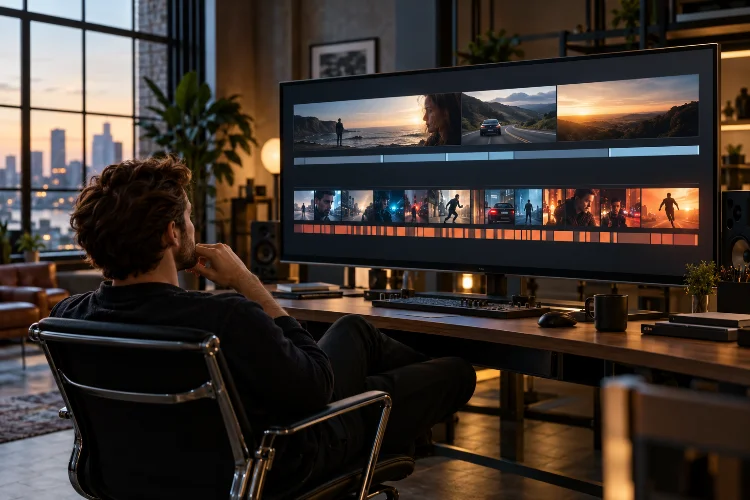
A video can feel fast without using extremely short shots. It can also feel slow even when the editor is cutting constantly. That is because perceived energy is not controlled by one factor alone.
Scene length plays a major role in how audiences experience momentum.
A short sequence can create urgency by delivering information quickly, while a longer scene can build pressure by refusing to let the viewer escape.
Editors use duration, internal movement, sound, performance, and visual density together to shape how energetic a video feels.
Adobe notes that pacing depends on how clips are arranged, how long they remain on screen, and how editing choices support the intended emotional tone.
For professional videos, this matters across commercials, corporate films, branded documentaries, interviews, event videos, and narrative projects. The goal is not simply to make scenes shorter.
It is to make each scene last exactly as long as its energy requires.
Scene Length Controls How Quickly Information Moves
Every scene delivers information.
The editor decides how quickly the audience receives it.
A 10-second scene showing one clear action feels very different from a 45-second scene containing several layers of dialogue, movement, and visual detail.
Shorter scenes often create a sense of forward motion because viewers are constantly being introduced to new information.
A promotional video might move from product design to manufacturing, testing, customers, and final results in rapid succession.
Each scene is brief, so the overall video feels active.
Longer scenes slow down that rate of change.
This can reduce perceived speed, but not necessarily energy.
A scene can remain intense if the information inside it continues evolving.
That distinction is important.
Duration affects pacing, but internal action affects how the duration feels.
Short Scenes Can Create Momentum
Short scenes are commonly used when editors want to create drive.
Commercials, sports videos, trailers, launch films, and event recaps often rely on compact scenes that introduce one clear visual idea before moving to the next.
This creates progression.
StudioBinder explains that shorter shot durations can increase intensity and create faster editorial rhythm, while longer durations can give viewers more time to process a moment.
Imagine a 30-second automotive ad.
One scene shows the car accelerating.
Another shows the suspension.
Another reveals the interior.
Then the driver reacts.
Each section lasts only a few seconds.
The constant arrival of new information creates energy even if individual camera movements are relatively smooth.
The audience rarely settles into one visual idea for long.
That instability of attention can feel exciting when used intentionally.
Longer Scenes Can Build Intensity Instead of Reducing It
Longer scenes are often assumed to feel slow.
That is not always true.
A long scene can become extremely tense when audiences know something important is unfolding and the editor refuses to cut away.
Think of a difficult interview, a countdown, or a character walking toward an uncertain situation.
The duration increases pressure because viewers remain inside the moment.
StudioBinder’s pacing guidance emphasizes that slower editing can create suspense, anticipation, and emotional weight when the story supports it.
This is why scene length should not be confused with low energy.
A 60-second sequence following a chef through a crowded kitchen may feel more energetic than a 10-second static interview.
The scene is long, but the environment changes constantly.
Energy depends on what happens inside the time.
Internal Movement Changes How Long a Scene Feels
Two scenes can have identical duration and feel completely different.
A 20-second locked-off interview shot may feel calm.
A 20-second tracking shot following someone through a busy factory can feel fast.
The difference is internal movement.
Camera motion, blocking, background activity, changing composition, and subject movement all influence perceived energy.
Adobe notes that tracking shots can create momentum and immersion by allowing audiences to move through space with the subject.
This means editors do not judge scene length using seconds alone.
They also consider how much visual change occurs during those seconds.
A longer shot containing constant movement may not need additional cuts.
A static scene with very little change may require tighter editing to maintain attention.
Professional pacing comes from combining duration with internal activity.
Information Density Affects Perceived Speed
A scene containing more information often feels faster than its actual duration suggests.
Consider a 15-second wide shot of an empty office.
Now compare it with a 15-second shot showing five employees moving between desks, screens changing, phones ringing, and a presenter walking through frame.
Both scenes last exactly the same amount of time.
The second feels busier because the viewer has more to process.
This is information density.
Editors need to consider how much cognitive work each scene demands.
A complex infographic may require longer screen time than a simple close-up.
A busy factory scene may already contain enough movement that fast cutting becomes unnecessary.
If editors shorten visually dense scenes too aggressively, audiences may feel overwhelmed.
Energy turns into confussion.
Good pacing balances stimulation with comprehension.
Scene Length Shapes Emotional Weight
Longer scenes can signal importance.
When an editor stays with a moment, viewers understand that they are expected to pay attention.
This works especially well in interviews, testimonials, documentary moments, and narrative scenes.
A brief statement may pass quickly.
A longer scene containing pauses, reactions, and silence can feel emotionally significant.
Walter Murch’s Rule of Six prioritizes emotion when deciding where to cut, placing feeling above purely technical concerns such as continuity.
This principle applies to scene duration too.
If the emotion is still developing, ending the scene early may weaken it.
If the emotional point has already landed, staying too long can reduce impact.
The editor’s responsibility is recognizing when the audience has fully experienced the moment.
Fast Cutting Does Not Automatically Create High Energy
One of the most common editing mistakes is assuming that more cuts equal more excitement.
They do not.
Fast cutting can feel energetic when the images contain clear progression.
But if every shot is similar, constant cutting may simply feel repetitive.
Imagine an interview edited between five nearly identical angles every second.
Technically, the pace is fast.
Emotionally, nothing meaningful changes.
The sequence may feel restless instead of exciting.
Strong perceived energy usually comes from change in information, movement, emotion, or sound.
Cuts are only one method of creating that change.
Professional editors therefore ask whether each transition moves the viewer forward.
If the new shot adds nothing, shortening the scene may not improve energy at all.
Longer Takes Can Increase Immersion
Long scenes can also create energy through immersion.
When viewers remain inside one continuous shot, they experience time more directly.
This is particularly effective when the camera travels through an environment.
Adobe explains that tracking shots can maintain continuity and make audiences feel physically connected to the action.
Imagine following a hospital worker through several departments without cutting.
The scene may last 45 seconds, but movement, dialogue, doors opening, people crossing, and changing environments keep the sequence active.
A traditional montage could show the same information in 15 seconds.
The montage would feel faster.
The long take might feel more immersive.
Both approaches have energy, but they express it differently.
Scene length therefore shapes not just speed, but the type of engagement audiences experience.
Sound Can Make Long Scenes Feel Faster
Audio dramatically affects perceived pacing.
A relatively long scene can feel energetic if the soundtrack contains rhythmic sound, fast dialogue, layered ambience, or accelerating music.
A short scene can feel calm if the sound design is soft and minimal.
This means perceived energy does not come only from picture editing.
Music can create forward momentum.
Sound effects can punctuate motion.
Dialogue can accelerate information flow.
Silence can suddenly slow everything down.
Adobe’s editing guidance emphasizes the relationship between image, audio, pacing, and emotional tone during post-production.
Editors should therefore evaluate scene length with sound active.
A sequence that feels too long when muted may work perfectly once the audio rhythm is complete.
Contrast Makes Scene Length More Powerful
Scene duration gains meaning through contrast.
A 20-second scene does not feel long if every previous scene also lasts 20 seconds.
But place it after a rapid montage of one-second shots and it suddenly feels enormous.
Editors use this contrast deliberately.
A fast product montage may stop on one longer hero shot.
A noisy event sequence may transition into a quiet interview.
A slow documentary section may suddenly accelerate during a crisis.
The change in scene length resets the audience’s attention.
This is why uniform pacing often feels flat.
If every scene has the same approximate duration, the viewer quickly predicts the rhythm.
Variation creates emphasis.
A longer scene says, “Stay here.”
A short scene says, “Keep moving.”
Scene Length Should Match Content Purpose
Different professional videos require different pacing strategies.
A luxury brand film often benefits from longer scenes because the audience needs time to appreciate design, materials, and atmosphere.
A sports campaign may rely on shorter sections to communicate intensity.
An educational video needs enough duration for comprehension.
A corporate documentary may alternate between slower interviews and faster workplace footage.
There is no universally correct scene length.
The purpose of the content determines the ideal pacing.
Platform also matters.
A short vertical ad has limited time to establish relevance, while a five-minute documentary can build interest more gradually.
Editing should respond to audience expectations without blindly copying current trends.
Fast does not always mean modern.
Slow does not always mean cinematic.
Purpose should come first.
Scene Length and Viewer Fatigue Are Closely Connected
High energy cannot continue indefinitely.
If every scene is short, dense, loud, and fast, the audience may become tired.
Editors need recovery moments.
A slower scene gives viewers time to reset before the next burst of information.
This is similar to music.
A song feels more powerful when loud sections are contrasted with quieter ones.
Video pacing works the same way.
Editors can deliberately lower the energy level for a few seconds so the next fast sequence feels stronger.
Without those changes, maximum intensity becomes normal.
Once everything feels intense, nothing feels especially intense.
This varation is essential in longer professional videos.
Energy needs a curve, not a flat line.
Scene Endings Influence the Energy of the Next Sequence
The end of one scene also affects how the next begins.
A scene can finish on movement, dialogue, silence, or a strong visual reveal.
Each choice creates a different transition of energy.
Cutting on motion can carry momentum forward.
Ending with silence can create a pause before a new section.
Finishing on an unresolved question can pull the audience into the next scene.
Editors therefore think about scenes as connected units rather than isolated blocks.
The final seconds of one sequence often determine how viewers receive the next.
Good pacing flows across scene boundaries.
Energy is cumulative.
The audience should feel that each section either continues, interrupts, increases, or releases what came before.
Professional Editors Test Scene Length Repeatedly
Scene duration is rarely perfect on the first edit.
Editors often shorten, extend, rearrange, and rebuild sequences several times.
Adobe recommends refining pacing during the rough-cut process before focusing heavily on finishing effects.
This is practical advice.
A scene that seems slow in isolation may work perfectly when placed between two fast sequences.
Another may feel effective during the first viewing but repetitive after seeing the complete video.
Editors need context.
Watching the full sequence helps reveal where attention drops, where energy peaks too early, and where audiences need more breathing room.
Small changes of only a few seconds can significantly improve the overall rhythm.
Scene length influences perceived energy in professional videos by controlling information flow, emotional weight, visual density, rhythm, and the amount of time audiences spend inside each moment.
hort scenes can create momentum, while longer scenes can build tension, immersion, or importance.
The key is not making everything shorter.
It is matching duration to what the scene needs to accomplish.
When editing your next project, look beyond the timeline numbers. Ask whether the scene is still revealing new information, building emotion, or moving the audience forward. Shorten sections that have already made their point, but allow important moments to breathe.
When scene length and content work together, perceived energy becomes easier to control – and the entire video feels more intentional.
