


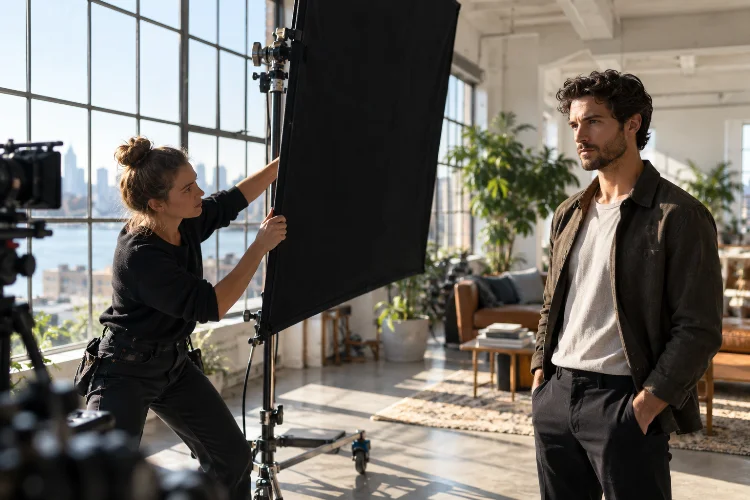
When a video image looks flat, the instinctive solution is often to add more light. Another softbox goes up, fill is increased, or a reflector is placed near the subject.
Sometimes the better solution is exactly the opposite.
Negative fill is the technique of removing unwanted bounced light from a subject by placing dark, non-reflective material nearby. Instead of illuminating the shadow side of a face, cinematographers deliberately prevent ambient light from reaching it.
StudioBinder explains that black flags, duvetyne, and other dark fabrics can be used to eliminate unwanted reflected light when a scene needs more contrast.
The technique sounds simple, but it can dramatically change professional video. Faces gain dimension, backgrounds become easier to separate, lighting ratios become more controlled, and bright locations stop looking excessively flat.
Negative fill is especially useful because it does not create another visible light source. It simply gives existing light more shape.
Negative Fill Is Subtractive Lighting
Most lighting discussions concentrate on adding illumination.
Key lights add direction. Fill lights reduce shadows. Backlights create separation.
Negative fill works differently.
Instead of adding another source, the cinematographer places a dark surface where unwanted bounced light is coming from. That surface absorbs some of the light rather than reflecting it back toward the subject.
No Film School describes this approach as subtractive lighting: controlling contrast by taking light away rather than continuously adding more fixtures.
Imagine filming someone beside a large window in a white room.
The window provides a beautiful soft key, but the opposite white wall reflects so much light back onto the face that both sides become almost equally bright.
Placing a black flag near the shadow side absorbs some of that reflection.
The key remains unchanged.
The face suddenly has more shape.
Removing Bounce Creates Stronger Facial Definition
Human faces look three-dimensional because light and shadow reveal their structure.
Cheekbones, jawlines, noses, eye sockets, and skin texture all become easier to perceive when there is tonal separation across the face.
Too much ambient bounce can reduce that separation.
The result is not necessarily bad, especially for beauty or high-key work, but it may feel flatter than the cinematographer wants.
Negative fill restores contrast.
Shutterstock’s cinematography guide demonstrates how adding a floppy or dark surface beside a subject can reduce illumination on one side of the face and create a more dimensional appearance.
This can be particularly effective in interviews.
A soft key may still keep skin flattering, while negative fill on the opposite side prevents the face from becoming evenly illuminated.
The subject looks natural but more sculpted.
Bright Rooms Often Need Negative Fill the Most
White walls are useful because they bounce light everywhere.
They are also difficult when you want contrast.
A small room with white walls, a pale ceiling, and a bright floor can behave like a giant softbox. Light from the key bounces repeatedly through the space until shadows become extremely weak.
Adding another light usually makes the problem worse.
Negative fill helps stop that uncontrolled bounce.
StudioBinder specifically points to reflected wall light as a common reason cinematographers use black flags or dark fabrics.
Placing a 4×4 solid close to the shadow side can produce a noticeable difference.
Moving it farther away reduces the effect.
This makes negative fill surprisingly adjustable.
The closer and larger the dark surface appears from the subject’s perspective, the more bounced light it can block or absorb.
Distance Determines How Strong the Effect Becomes
Negative fill follows an important practical principle: proximity matters.
A small black card positioned very close to a face can sometimes create more noticeable shadow than a much larger surface positioned far away.
Why?
Because the closer surface occupies more of the environment visible from the subject’s shadow side.
Instead of seeing a bright wall that returns light, the subject effectively “sees” a large dark surface.
Cinematographer Neil Oseman notes that negative fill can be created using flags, black fabric, blackout material, black reflector surfaces, and similar non-reflective materials.
This gives crews flexibility.
For a tight close-up, a relatively small flag might be enough.
For a full-body exterior, the production may need a much larger black solid positioned close to the performer.
Scale should follow framing.
Negative Fill Increases Lighting Ratios
Negative fill directly affects contrast.
If the key side remains unchanged while the shadow side becomes darker, the key-to-fill relationship increases.
This is one reason negative fill appears frequently in low-key cinematography.
Filmmakers Academy explains that low-key lighting typically uses limited fill and higher lighting ratios, with black boards or flags sometimes used to absorb ambient light and deepen shadows further.
For example, an interview may initially have fairly even facial exposure because ambient light fills the shadows.
Adding negative fill could reduce the shadow side by one or two stops.
The face now has more dramatic tonal separation even though no lamp has changed output.
This is useful because it allows cinematographers to modify contrast without disturbing the key source.
The lighting becomes easier to control.
It Can Create Depth Between Subject and Background
Negative fill does not only shape faces.
It can also help separate subjects from their environment.
Suppose a person is standing against a bright neutral wall.
If soft light fills both the subject and background evenly, the image may lack depth.
Darkening the shadow side of the subject creates more tonal variation.
Now one side of the person contrasts differently against the background.
This subtle difference helps the image feel less two-dimensional.
No Film School describes negative fill as a way to increase purposeful contrast and add dimensionality to a scene.
Production design and background exposure still matter, of course.
But controlled shadow can give the cinematographer another layer of separation without immediately reaching for a backlight.
Exterior Daylight Benefits From Subtractive Lighting
Negative fill is extremely useful outdoors.
Open shade may appear beautifully soft to the eye, but light arrives from almost every direction because the sky, buildings, pavement, and surrounding objects all reflect illumination.
Faces can become surprisingly flat.
A large black solid positioned beside the subject removes part of this environmental fill.
No Film School notes that negative fill can be particularly useful outdoors because natural environments contain countless reflective surfaces bouncing daylight back toward the subject.
Imagine filming a presenter beneath an awning.
The open sky creates the main illumination, while a pale building opposite reflects additional light into the shadow side.
Placing a large black cloth near that side reduces the reflection and restores facial contrast.
No electricity is required.
The crew is simply controlling what the environment reflects.
Negative Fill Can Make Soft Light More Cinematic
Soft light and strong contrast are not opposites.
This is an important distinction.
A very large diffused key can produce beautifully soft transitions across skin while negative fill keeps the opposite side noticeably darker.
The light remains soft because source size has not changed.
The contrast increases because fill has decreased.
This combination is common in polished interview and narrative cinematography.
The subject receives flattering illumination without appearing completely flat.
It is also one reason negative fill can look sophisticated.
Rather than making the key harder or more aggressive, cinematographers preserve the quality of the light and adjust the contrst around it.
Subtle subtraction can therefore create more depth than simply increasing fixture output.
Flags, Floppies, and Duvetyne Offer Different Options
Negative fill does not require one specific piece of equipment.
Professional crews frequently use solids, floppies, black flags, duvetyne, blackout fabrics, or black foam boards.
A floppy is particularly useful because its additional fabric panel can extend downward, creating a larger dark area when needed.
Duvetyne works well when crews need to cover a wall or create a much larger surface.
Smaller productions can improvise with black foam core, dark curtains, or the black side of a 5-in-1 reflector.
Neil Oseman notes that even basic black materials can work because the principle is simply to absorb light instead of returning it.
The expensive part is not the material.
The skill lies in deciding where to put it.
Negative Fill Should Follow the Key Direction
Subtractive lighting works best when it supports the existing lighting logic.
If the key comes from camera left, negative fill will commonly be placed toward camera right to strengthen the shadow side.
But that is not an absolute rule.
The goal is shaping the image rather than following a diagram.
A cinematographer may place negative fill behind the subject to prevent background bounce from wrapping around them.
It may be positioned below a face to remove floor reflection.
Large overhead blacks can reduce light from a bright sky.
Thinking spatially is more useful than simply saying “put a black flag opposite the key.”
Identify where unwanted light is actually coming from.
Then remove it.
Too Much Negative Fill Can Become Unnatural
More contrast is not automatically better.
Placing a large black surface extremely close to someone can make the shadow side unnaturally dark, particularly in an environment that should realistically contain substantial ambient light.
This can create a stylized result that no longer matches the location.
It can also push skin into exposure levels that are difficult to recover.
The technique therefore requires judgement.
Filmmakers Academy connects deeper negative fill with low-key, high-contrast aesthetics such as drama, suspense, mystery, and noir-inspired imagery.
Those styles may benefit from very deep shadows.
A friendly healthcare commercial probably will not.
Negative fill should support the emotional tone and lighting logic of the project.
It Helps Maintain Consistency Between Camera Angles
Professional scenes frequently require several pieces of coverage.
The wide shot may receive a certain amount of natural bounce, while a close-up suddenly looks flatter because the camera and crew repositioned reflective surfaces nearby.
Negative fill gives cinematographers more control over those changes.
If one side of the face should remain consistently darker, a solid can be repositioned for each setup while maintaining roughly the same contrast relationship.
This becomes important in interviews and dialogue scenes.
A close-up that suddenly has almost no shadow can look disconnected from the wider shot.
Using negative fill deliberately helps preserve visual consistancy even when equipment must move substantially between angles.
Negative Fill Can Reduce the Need for More Equipment
One of the best things about negative fill is efficiency.
A flat image does not always need another expensive lamp.
Sometimes a $20 piece of black foam board improves the shot more than adding another LED panel.
That matters on small crews and location productions.
Additional fixtures require stands, power, cables, modifiers, setup time, and sometimes additional crew.
Negative fill can achieve a major visual change using passive material.
No Film School emphasizes that the technique is both practical and relatively inexpensive because it works through light control rather than additional output.
For filmmakers learning lighting, this is an important lesson.
Professional cinematography is often about controlling existing light rather than constantly creating more of it.
Negative Fill Works Best When Judged on Camera
Human eyes adapt quickly to changes in brightness.
A difference that seems subtle in person may look much stronger through the camera.
For that reason, negative fill should be evaluated using the actual monitoring setup.
Waveforms, false color, exposure meters, and properly calibrated monitors can help crews understand how far shadows are being pushed.
The black surface can then be moved closer or farther away.
The goal is not simply making one side dark.
It is controlling exactly how much information remains there.
Digital cameras can retain substantial shadow detail, but extremely dark areas may become noisy or difficult to grade.
Good negative fill creates purposeful contrast without accidentally destroying usable information.
Shape Should Always Serve the Story
Negative fill is often associated with a “cinematic look,” but using it everywhere can become formulaic.
A high-key commercial may intentionally require very little facial contrast.
A comedy may benefit from open, bright illumination.
A suspenseful documentary interview may need much stronger shadow.
The technique should follow the emotional objective.
Subtractive lighting becomes powerful because it gives cinematographers another dimension of control.
Instead of asking only, “Where should I put a light?” they can also ask, “Where should light be prevented from going?”
That second question often separates basic illumination from intentional cinematography.
Negative fill creates shape and depth in professional video by removing unwanted bounced light rather than adding another source.
Black flags, solids, duvetyne, floppies, and other dark materials can deepen shadows, increase lighting ratios, improve facial modeling, and separate subjects more effectively from their environments.
Its biggest advantage is control.
A bright room or open-shade exterior may already contain plenty of light. What it lacks is direction and contrast.
On your next shoot, try looking for unwanted reflection before reaching for another fixture. Place a dark surface near the shadow side, watch how the face changes, and adjust the distance gradually.
Learning when to subtract light can be just as important as learning how to add it – and often produces a more dimensional, deliberate image.
