


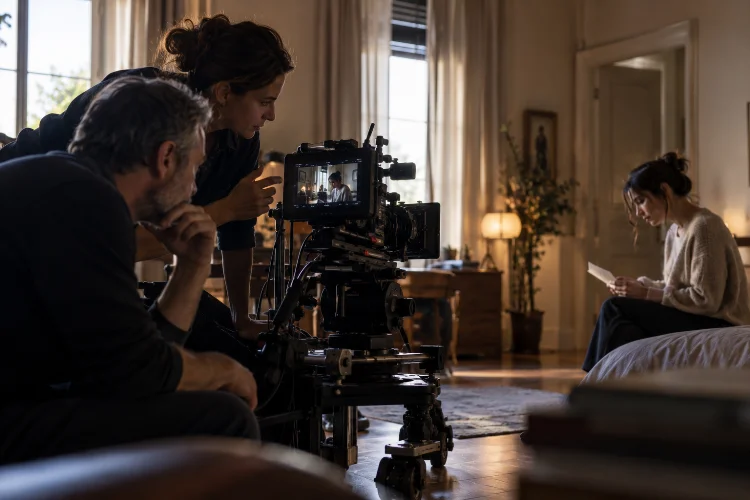
Smooth gimbal shots, dramatic crane moves, fast tracking sequences, and slow cinematic push-ins can instantly make video look impressive.
With modern stabilization equipment becoming easier to use, filmmakers have more ways than ever to keep the camera moving. But movement alone does not create good cinematography.
The stronger question is whether the camera is moving for a reason.
Camera movement should follow story rather than visual style because every pan, push, track, orbit, tilt, or handheld sequence changes how audiences interpret what is happening.
No Film School describes effective camera movement as “motivated” when it responds to what is happening in the scene and helps communicate the narrative rather than simply creating spectacle.
A beautiful movement without narrative purpose may attract attention to the camera itself. A simple movement at exactly the right moment can make audiences feel tension, intimacy, surprise, or emotional distance.
The goal is not to keep the camera moving. It is to know why it moves.
Story Motivation Gives Camera Movement Meaning
Before deciding how the camera should move, filmmakers should understand what the scene needs to communicate.
Is a character becoming more vulnerable? Is important information being revealed? Does the audience need to follow someone into a new environment? Should the moment feel chaotic or controlled?
These questions provide motivation.
No Film School describes motivated camera movement as movement that responds to on-screen action and helps advance the story.
Imagine two people having a difficult conversation.
A director could orbit around them simply because the movement looks sophisticated. But if nothing changes emotionally during the conversation, the orbit may feel decorative.
Now imagine the camera begins completely still. As the disagreement becomes more intense, it slowly starts moving around the characters.
The movement now communicates escalation.
The technique is identical. The storytelling intension is what gives it meaning.
Movement Can Direct Audience Attention
One of the camera’s most important jobs is deciding where viewers should look.
Camera movement can guide that attention without requiring dialogue or editing.
A tracking shot may begin with an employee walking through a factory and gradually reveal a massive production line behind them. A slow pan might move from one character to another just as the second person reacts to important news.
The movement determines when information becomes visible.
Adobe notes that tracking shots require purposeful planning around where they can support storytelling and help viewers connect with characters.
This means camera movement can function almost like punctuation.
A push-in says, “Pay closer attention.”
A pullback can say, “Look at the larger situation.”
A reveal can say, “There is something here you did not know before.”
When those choices come directly from the story, viewers usually experience the meaning before they consciously notice the technique.
Push-Ins Work Best When Something Changes
The push-in is one of the most widely used cinematic camera movements.
The camera physically moves toward a subject, gradually reducing the distance between the viewer and the character.
StudioBinder explains that dolly-ins can emphasize dialogue, emotion, or moments of realization.
That is precisely why push-ins become more effective when something changes emotionally.
Imagine an interview subject discussing their company’s history.
For the first minute, the camera remains static.
Then the person begins talking about almost losing the business during a crisis. A slow camera move starts at exactly that moment.
The audience gradually gets closer as the conversation becomes more personal.
Now compare that with a camera constantly pushing in and pulling out throughout the entire interview simply because the filmmaker wants cinematic movement.
The technique loses meaning.
Movement becomes visual decoration instead of emotional emphasis.
Tracking Shots Should Have a Narrative Destination
Tracking shots are popular because they create movement, depth, and energy.
But simply following someone down a corridor does not automatically make a sequence interesting.
The question is where the journey takes the audience.
StudioBinder notes that tracking shots can place viewers within the action, establish continuity, and create excitement.
A useful tracking shot often contains progression.
Perhaps the camera follows a young engineer through a quiet hallway, enters a large testing facility, passes several teams working on prototypes, and finally arrives at an experimental vehicle.
The movement has a destination.
Every part of the shot reveals more about the environment and the organization.
If the same engineer simply walks around the building while the camera follows without revealing anything useful, the shot might still look polished—but its narrative value is limited.
Movement becomes stronger when audiences discover something along the way.
Camera Stability Can Reflect Emotional Stability
The physical character of camera movement can also support story.
Smooth dolly movement feels different from handheld footage.
A dolly is designed to create stable and controlled movement, while handheld shooting naturally introduces more irregular motion.
StudioBinder explains that dolly shots can smoothly move audiences into, away from, or alongside action, with different movements influencing pacing and emotional connection.
Filmmakers can use those differences deliberately.
Imagine a documentary about a company going through a major crisis.
Before the crisis, the visual language might use controlled tripod compositions and precise dolly movements. When operations begin collapsing, the film could shift toward handheld photography.
The change in camera behavior mirrors the change in the story.
Once stability returns, controlled movement can return as well.
The difference between those styles now carries narrative information instead of simply reflecting aesthetic preference.
Stillness Can Be More Powerful Than Movement
A common mistake is assuming that professional video needs constant movement.
It does not.
Sometimes refusing to move the camera creates more impact.
No Film School warns that movement without discernible motivation can distract audiences by drawing attention to the filmmaking technique itself.
Consider an emotional interview.
If the speaker is describing a deeply personal experience, a static close-up may be more effective than an orbiting gimbal shot.
The absence of movement removes distraction.
The audience focuses entirely on the person’s expression and voice.
Stillness can also create tension.
If every previous scene contains energetic tracking shots and the camera suddenly becomes completely motionless, audiences may intuitively feel that something has changed.
Good cinematography therefore involves choosing between movement and stillness rather than automatically assuming one is more cinematic.
Blocking Should Motivate the Camera
Actors and subjects provide natural reasons for cameras to move.
If someone stands up and crosses the room, the camera may track with them.
If two people seperate during an argument, a pullback could emphasize their increasing distance.
This connection between blocking and camera movement makes scenes feel organic.
The camera appears to respond to the people inside the story rather than performing movements independently.
Tracking shots demonstrate this particularly well. StudioBinder explains that they typically follow moving characters, while factors such as framing, movement direction, blocking, staging, and duration affect the storytelling result.
Professional directors therefore often develop blocking and camera placement together.
Instead of deciding that a scene “needs a gimbal shot,” they might first determine how the character moves through the environment.
The camera solution follows.
That process generally produces movement that feels integrated rather than added afterward.
Movement Speed Should Match Story Rhythm
Even when the direction of a camera move remains identical, changing its speed can completely alter the feeling.
A slow tracking shot can create suspense.
A rapid movement can generate urgency and energy.
StudioBinder’s analysis of tracking techniques notes that movement speed influences mood: slower tracking can contribute to suspense, while faster motion can increase energy.
This makes pacing an important storytelling decision.
Imagine a chef working during a quiet morning preparation period. Slow lateral moves could emphasize precision and craftsmanship.
Later, during an intense dinner service, faster movement could follow staff navigating the kitchen.
The camera language evolves with the situation.
If both scenes were captured using the exact same movement speed because it matched the video’s visual style, the contrast between calm preparation and intense service would become weaker.
Visual consistancy does not mean every shot needs identical movement.
It means the cinematography should consistently support the story.
Lens Choice Changes What Movement Communicates
Camera movement does not work independently from lens choice.
Moving through a scene with a wide lens can emphasize depth and speed because foreground objects change size quickly.
Longer lenses compress distance and create a different sense of movement.
StudioBinder’s tracking-shot guidance highlights lens choice, framing, direction, stabilization, blocking, and speed as interconnected considerations when designing moving shots.
This gives cinematographers another storytelling tool.
A wide lens following a character through a crowded environment can make the space feel active and immersive.
A tighter lens following the same person might isolate them from the background and make the moment feel more internal.
The physical camera path could remain almost identical.
The emotional result changes because the lens changes how space is represented.
Choosing equipment should therefore happen after identifying what the audience needs to experience.
Visual Style Should Support the Story, Not Compete With It
Strong visual style is not the enemy.
Some of the most memorable films, advertisements, music videos, and branded productions have extremely distinctive camera languages.
The problem appears when filmmakers design movement primarily to demonstrate technique.
A dramatic crane shot, complicated gimbal orbit, or elaborate tracking move can look impressive while still weakening the scene if it distracts from the subject.
Style should emerge from repeated storytelling choices.
If a project is about precision engineering, highly controlled mechanical camera movement might reinforce that theme.
If the story focuses on spontaneous human experiences, subtle handheld imagery might feel more appropriate.
The goal is to make visual style and narrative purpose reinforce each other.
When viewers notice the character, emotion, product, or idea before they notice the equipment used to capture it, the cinematography is usually doing its job.
Planning Movement Prevents Unnecessary Complexity
Story-driven movement should begin during preproduction.
Adobe notes that tracking shots require extra planning because the camera needs to coordinate with performers, lighting, and moving elements.
Storyboards, shot lists, location scouts, and rehearsals help determine whether a complicated movement is actually necessary.
A director might initially imagine a long Steadicam sequence.
During storyboarding, the team realizes that the scene only needs one reveal and one emotional close-up. Two simpler shots might communicate those ideas more effectively.
Removing unneccessary complexity can improve both the production schedule and the finished video.
It also protects resources for shots where sophisticated movement genuinely adds value.
Technical difficulty should never be confused with storytelling quality.
The Best Camera Movement Often Feels Invisible
Powerful camera movement does not always announce itself.
Sometimes audiences barely notice that the camera has moved.
A slow dolly might subtly transform a medium shot into an intimate close-up over twenty seconds. A lateral move could quietly reveal another character standing in the background.
The audience experiences the emotional change without consciously analyzing the technique.
That is often a sign of effective visual storytelling.
Instead of asking, “How can we make this shot look more cinematic?” filmmakers can ask a better series of questions:
What should the audience notice? How should they feel? When should new information appear? Whose perspective matters?
Once those questions are answered, the appropriate movement usually becomes much clearer.
Camera movement should follow story rather than visual style because movement communicates emotion, perspective, information, rhythm, and attention.
A push-in can create intimacy, a pullback can reveal isolation, tracking can immerse viewers, handheld imagery can introduce instability, and complete stillness can give an important moment more weight.
The technique itself is never the final goal.
Before adding a dolly, gimbal, crane, slider, or complicated tracking shot to your next video, ask what changes for the audience because the camera moves. If the answer is only “it looks cinematic,” reconsider the shot.
Build movement around character, blocking, emotion, information, and pacing. When the story motivates the camera, visual style usually becomes stronger naturally—because every impressive shot also has something meaningful to say.
