


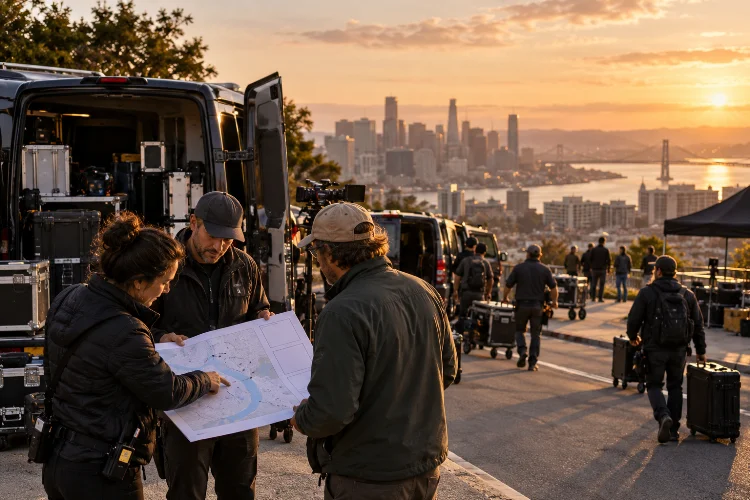
Shooting a video in one controlled studio is complicated enough. Add several offices, outdoor environments, rented venues, private homes, or locations in different cities, and the production suddenly becomes a logistical puzzle.
That is why production schedules matter so much in multi-location video projects.
A strong schedule does more than tell the crew what scene comes next. It connects travel time, location access, cast availability, lighting conditions, equipment movement, setup requirements, permits, weather, and daily shooting targets into one workable plan.
StudioBinder describes a shooting schedule as an outline of which scenes will be filmed on each production day, often including preparation, filming, meals, travel, company moves, and load-in or load-out time.
Without that structure, teams may spend more time moving than filming. Costs increase, daylight disappears, crew members become confused, and important shots can easily be missed.
For multi-location productions, scheduling is not simply administration. It is one of the main systems keeping the entire project under control.
Multi-Location Shoots Have More Moving Parts
Every new filming location introduces another group of variables.
A production may need different access times, parking arrangements, permits, power sources, equipment packages, security procedures, weather plans, and transportation routes for each place.
Those variables quickly become interconnected.
Imagine a corporate video being filmed at a factory in the morning, a downtown office in the afternoon, and an executive’s home at sunset. The team cannot simply list those three locations and assume everything will work.
Travel must be calculated. Equipment has to be packed. The factory may require safety clearance. The office might only allow filming after employees leave, while the final location depends on catching a specific quality of evening light.
A production schedule turns those individual requirements into one coordinated timeline.
Without it, even a small delay at the first location can affect the entire day.
Production Schedules Reduce Costly Company Moves
Moving an entire production unit between locations is much more complicated than driving from one address to another.
Cameras must be packed, lighting equipment secured, stands loaded, props checked, wardrobe transported, crew vehicles organized, and the original location cleared before everyone can move.
In film production, this is often called a company move.
StudioBinder specifically recommends keeping company moves to a minimum because packing equipment, gathering the crew, traveling, and setting up again can consume significant production time.
Good scheduling therefore groups scenes intelligently.
Instead of filming one scene at Location A, moving to Location B, and returning to Location A later, producers usually try to complete as much work as possible at one location before leaving.
That may mean shooting scenes out of narrative order.
The audience will never know, but the crew may save several hours.
Efficient location grouping also reduces fuel costs, transportation fees, equipment handling, and the risk of gear being misplaced during repeated moves.
Travel Time Becomes Part of the Production Day
One of the easiest scheduling mistakes is treating travel as empty space.
It is not.
A 40-minute drive does not necessarily mean the next scene can begin 40 minutes after the previous one ends. The crew still has to wrap the first setup, load vehicles, deal with traffic, find parking, unload equipment, and prepare the new location.
Professional production schedules account for this entire transition.
Asana recommends documenting location information, travel needs, parking, permits, weather, and environmental considerations alongside daily shooting plans.
This becomes especially important in large cities.
A location that looks only five kilometers away on a map might require an hour of actual production movement because of traffic, restricted loading zones, elevators, security checks, or limited parking.
Ignoring those details produces unrealistic schedules.
Once the schedule starts running late, teams often try to recover time by reducing takes or eliminating coverage.
That can eventually affect the quality of the final video.
Location Availability Determines the Shooting Order
Creative teams often want to shoot scenes in a particular sequence, but real-world location availability may make that impossible.
A restaurant might only permit filming before opening. An office may only be available on weekends. A hotel could allow production for three hours between guest periods.
Production scheduling has to balance these restrictions with the needs of the script.
This is why multi-location shoots are usually organized around logistics rather than story chronology.
StudioBinder’s scheduling tools allow productions to organize scenes using criteria such as shoot location, cast, preparation time, and estimated shooting duration.
That flexibility can dramatically improve efficiency.
For example, if four scenes take place in the same conference room but appear at different points in the finished video, filming all four during the same location window makes far more sense than returning several times.
Strong planning turns limited location access into a manageable constraint rather than a production emergency.
Daylight and Weather Need to Be Scheduled Carefully
Outdoor locations introduce another challenge: nature does not follow the production team’s schedule.
Sunrise, sunset, cloud cover, rain, wind, and changing light conditions can all influence how footage looks.
A production that needs a golden-hour establishing shot cannot simply film it whenever the crew happens to arrive.
That shot has a limited window.
Schedules should therefore prioritize time-sensitive scenes.
Less critical interiors can often be moved around, but sunset, sunrise, or weather-dependent shots usually need to remain fixed.
Asana’s shooting schedule guidance specifically recommends combining scene planning with weather forecasts and location details so teams can adapt when environmental conditions change.
This is where contingency planning becomes valuable.
If rain makes an outdoor location unusable, the crew might switch to a nearby interior scene instead of losing the day completely.
A schedule that contains flexible alternatives gives producers more room to react without creating unnesessary downtime.
Cast and Crew Availability Becomes Easier to Coordinate
Multi-location projects rarely require every person at every location.
A product specialist might only appear at a factory. The CEO may only be needed for an office interview. A makeup artist could be required for talent scenes but not landscape B-roll.
Scheduling allows producers to call people only when they are actually needed.
Backstage explains that call sheets are built from the production schedule and shot list, providing cast and crew with details such as call times, locations, parking, contacts, and shooting progress.
That is especially useful when locations change during the same day.
Instead of everyone arriving at one location and then traveling together unnecessarily, certain departments may receive staggered call times.
The lighting team could arrive early to prepare the second location while the camera unit finishes elsewhere.
This type of overlap can save valuable time, but only when communication is precise.
Poor coordiantion can easily result in people arriving at the wrong location or important crew members being unavailable when they are needed.
Equipment Logistics Depend on the Schedule
Different locations often require different equipment.
A small office interview may only need compact LED fixtures, while a warehouse scene could require powerful lighting, generators, lifts, long cable runs, or specialized camera support.
The schedule helps production departments understand when each piece of equipment is needed.
This matters because transporting everything everywhere is rarely efficient.
Certain equipment may be delivered directly to one location while other gear travels with the main camera unit.
Production managers can also organize rental periods more accurately.
If a specialty lens or crane is only needed on one specific shoot day, renting it for the entire production would unnecessarily increase costs.
StudioBinder’s production scheduling tools connect scene information with shoot locations, cast, preparation requirements, and other production details, making these dependencies easier to organize.
Good scheduling therefore improves both creative preparation and budget control.
A Clear Schedule Helps Control Production Costs
Time is one of the most expensive resources on a professional video set.
Every extra hour can affect crew wages, equipment rentals, location fees, transport, catering, and overtime.
Multi-location productions are particularly vulnerable because delays tend to compound.
If the first company move takes 30 minutes longer than expected, that delay may push lunch, shorten the next shooting window, and cause overtime at the final location.
A strong production schedule makes these risks easier to identify before filming starts.
Producers can add realistic buffers around complicated moves or heavy setups instead of assuming everything will happen perfectly.
They can also compare the creative value of each shot against the time required to capture it.
A complicated five-second crane shot might look impressive, but if it requires a two-hour setup during a tightly scheduled location day, the director may choose a more practical alternative.
Scheduling does not limit creativity.
It helps determine where production resources create the greatest impact.
Call Sheets Turn the Schedule Into Daily Instructions
The master production schedule provides the overall plan, but crews need more detailed information every day.
That is where call sheets become important.
StudioBinder notes that professional call sheets can include the daily agenda, crew call times, detailed scene schedules, shooting locations, parking information, weather, department notes, and company moves.
For a multi-location project, these details reduce ambiguity.
A crew member should not need to search through group chats to find out where the second location is or whether parking is available there.
The information should already be documented.
Modern production workflows can also update call sheets when changes occur, reducing the risk that someone continues working from an outdated schedule.
That matters because multi-location projects tend to generate more last-minute adjustments than controlled single-location shoots.
Clear daily communication keeps those changes from becoming costley mistakes.
Production Schedules Improve Continuity Across Locations
Location changes can also create creative continuity problems.
Scenes filmed days apart may eventually appear next to each other in the final edit.
Wardrobe, props, makeup, lighting direction, camera settings, and actor appearance therefore need to remain consistent.
Scheduling can help production teams track these relationships.
If two connected scenes require identical wardrobe or props, filming them close together may reduce continuity risk.
Likewise, scheduling similar lighting conditions can make editing easier.
Imagine a character walking out of one building and supposedly entering another building across the street.
In reality, those two locations could be miles apart.
If the exterior is filmed under bright midday sun while the entrance scene is captured during overcast evening light, the transition may feel visually strange.
Planning both scenes around compatible conditions can protect the illusion.
Flexible Schedules Make Unexpected Changes Easier to Manage
A production schedule should be detailed, but it should not be rigid.
Multi-location projects regularly encounter unexpected changes.
Traffic appears. Weather shifts. A location becomes unavailable. An actor arrives late. Equipment develops a technical problem.
A good schedule identifies which scenes are essential, which can be moved, and which backup options exist.
Asana recommends maintaining shooting schedules in a shared system so call times, scenes, crew assignments, and other details can be adjusted quickly when production conditions change.
This flexibility is especially useful when several locations exist within the same production.
If Location A becomes temporarily unavailable but Location B is ready, the team may be able to reverse the day’s order.
Without preparation, that kind of change becomes chaos.
With a structured schedule, it becomes a manageable production decision.
Production schedules matter in multi-location video projects because they connect every moving part of the shoot. Locations, cast, crews, equipment, travel, daylight, permits, weather, budgets, and company moves all compete for limited production time.
A realistic schedule turns those variables into a coordinated workflow.
It reduces wasted travel, protects important shots, improves communication, controls costs, and gives crews better options when unexpected problems appear. Most importantly, it keeps logistical challenges from taking attention away from the creative work.
Before your next multi-location shoot, avoid treating the schedule as a simple list of scenes. Build it around the real movement of people, equipment, and time.
The more accurately those details are planned, the smoother the production – and the stronger the final video – is likely to be.
