


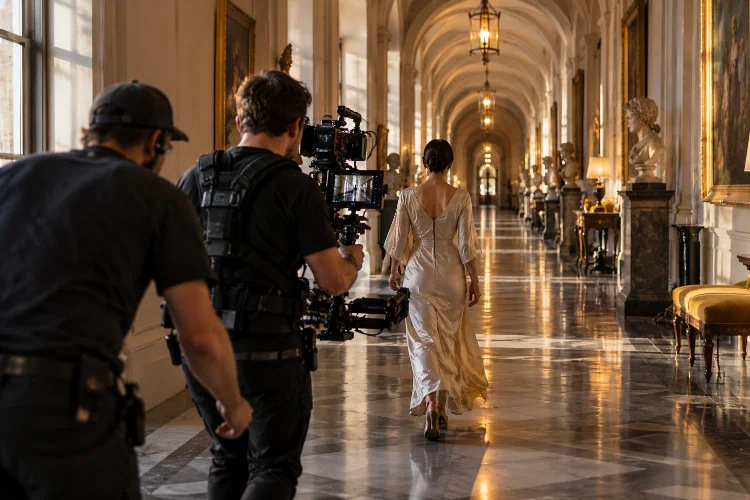
A character walks through a crowded building, crosses a hallway, enters another room, and discovers something important. The camera never cuts away. Instead, it travels with them, allowing the audience to experience the journey almost in real time.
That is the immersive power of a tracking shot.
Rather than observing action from a fixed position, tracking shots allow viewers to physically move through the story with the characters.
StudioBinder describes the technique as camera movement that follows a subject, helping place viewers in the middle of the action while establishing continuity, pacing, and emotional connection.
This is why tracking shots build immersion in narrative video projects so effectively. They can introduce unfamiliar environments, reveal information gradually, strengthen character perspective, or create tension simply by refusing to cut away.
The technique is not valuable because the camera moves. It becomes powerful when that movement makes audiences feel closer to the world, characters, and emotional experience of the story.
Tracking Shots Make Viewers Feel Physically Present
Traditional coverage often presents a scene through several separate camera positions.
A wide shot establishes the space, followed by medium shots, close-ups, and reaction shots. Editing connects those viewpoints afterward.
Tracking shots create a different experience.
Instead of jumping between positions, the audience travels continuously through the environment.
Adobe describes tracking shots as movements that follow action and can create a dynamic, immersive perspective. The technique may place viewers beside, behind, or in front of characters as they move.
This continuous movement can make audiences feel physically present.
Imagine following a journalist entering a crowded event. The camera moves through security, passes conversations, follows the journalist down a corridor, and finally reaches the main hall.
Viewers do not simply see the destination.
They experience the process of arriving there.
That difference can make a fictional environment feel far more believable.
Continuous Movement Strengthens Spatial Awareness
Immersion depends partly on understanding where things exist in relation to each other.
Frequent cuts can sometimes fragment that geography.
A tracking shot can preserve it.
When the camera moves continuously through a location, viewers see how one room connects to another, where characters are positioned, and how large or complicated an environment really is.
Adobe points to the famous Goodfellas Copacabana sequence as an example of movement that brings audiences through several connected environments while introducing them to the characters’ world.
This principle works equally well in smaller narrative projects.
Suppose a short film takes place inside a restaurant.
Instead of using separate establishing shots for the kitchen, dining area, hallway, and entrance, one tracking shot could follow a waiter through all four spaces.
The audience quickly develops a mental map.
Once that geography has been established, later scenes become easier to understand because viewers already know how the world fits together.
Following Characters Creates Emotional Proximity
Tracking movement does not only connect audiences with locations.
It can connect them with people.
When the camera stays close to a character as they move, viewers experience events at roughly the same pace and distance as that character.
Adobe notes that tracking shots can create deeper character connections and communicate complex emotion by keeping audiences physically close to moving subjects.
Imagine following a nervous employee walking toward an important meeting.
The camera stays slightly behind them.
Their breathing becomes louder. People pass in the background. The meeting room slowly gets closer.
Very little dialogue is required.
Because the camera remains attached to the character’s journey, the audience begins sharing the anticipation.
A static wide shot might show exactly the same action, but it would create more emotional distance.
The tracking shot makes the experience feel personal.
Tracking Shots Can Reveal Information Gradually
One of the strongest features of camera movement is its ability to control when audiences receive information.
A static wide shot reveals most of the frame immediately.
A moving shot can delay that information.
The camera may follow a character around a corner and suddenly reveal a crowd. It may move beside someone through a narrow corridor before exposing a huge landscape outside.
This creates visual discovery.
StudioBinder explains that tracking shots can introduce new characters and locations while directing audience attention toward important story information.
The technique therefore works almost like controlled curiosity.
Viewers wonder what lies beyond the current frame because the camera is actively taking them somewhere.
That forward momentum encourages attention.
In a mystery project, the effect can build suspense. In an adventure story, it creates discovery. In a corporate narrative, it might reveal a production environment or introduce different teams through one continuous journey.
The camera path becomes part of the storytelling structure.
Long Tracking Shots Can Increase Tension
Cuts give audiences psychological breaks.
Tracking shots can remove those breaks.
When a scene continues without an obvious edit, viewers stay trapped inside the same flow of events.
Adobe highlights The Shining as a famous example, where prolonged tracking through the hotel’s corridors contributes to dread and tension. The camera follows Danny through an environment that gradually becomes more threatening.
The movement itself is relatively smooth.
The tension comes partly from anticipation.
Audiences continue moving forward without knowing what will appear next.
This principle can work in much smaller productions.
Consider a short thriller in which a character searches an apparently empty office after hours. Instead of cutting between rooms, the camera follows continuously.
Every doorway becomes a possible reveal.
Every dark corridor remains visible long enough for the audience to study it.
That sustained perspective creates a feeling of vulnerability that rapid editing might reduce.
Movement Can Establish the Rhythm of a Scene
Tracking shots also influence pacing.
Fast movement can create energy and urgency. Slow movement can feel contemplative, suspenseful, or intimate.
Adobe notes that tracking shots have been used for everything from quiet emotional moments to chaotic action sequences, with movement speed contributing to the rhythm of the scene.
Consider two versions of someone walking through a train station.
In the first, the camera moves slowly beside them while they observe the environment.
The sequence might feel reflective.
In the second, the camera moves quickly backward while the character rushes through the crowd.
The same location suddenly feels stressful.
The technique has not fundamentally changed.
The pacing has.
This means tracking speed should not be chosen simply because faster movement looks energetic. It should support the emotional rhythm of the scene.
Foreground Movement Creates Stronger Visual Depth
Tracking shots become particularly immersive when objects exist at different distances from the camera.
As the camera moves, nearby objects travel across the frame faster than distant ones.
This creates parallax.
A character walking through a forest, warehouse, kitchen, market, or crowded street therefore produces stronger dimensionality than the same person moving across an empty wall.
Foreground elements may briefly block the camera.
Background objects shift position.
The subject changes spatial relationships with the environment.
These visual cues make the image feel three-dimensional.
For narrative video, this can transform relatively ordinary spaces into more engaging worlds.
A filmmaker might intentionally design a path past doors, furniture, columns, people, vegetation, or machinery.
The tracking route is therefore not simply about reaching point B.
The environment along the route becomes part of the visual storytelling.
Different Tracking Positions Create Different Relationships
Tracking does not always mean following someone from behind.
The camera can move in front, beside, around, or even above the subject.
Each position creates a different relationship.
Following from behind often gives the impression that viewers are entering the environment with the character.
Moving backward in front of someone allows audiences to study their expression while still experiencing forward movement.
Lateral tracking shows both the subject and the changing environment.
StudioBinder identifies lateral movement as especially useful for walk-and-talk scenes because it preserves interaction while maintaining a sense of physical progression.
The choice should come from narrative perspective.
If a character is exploring an unfamiliar place, following from behind may emphasize discovery.
If their reaction is more important than the location, moving in front may work better.
The camera path is effectively deciding what aspect of the experience the audience should share.
Equipment Changes the Character of the Movement
Tracking shots can be created with dollies, Steadicams, gimbals, handheld rigs, vehicles, cranes, and other systems.
The equipment affects how the movement feels.
StudioBinder notes that tracking originally referred largely to movement along dolly tracks, while modern filmmaking commonly uses lighter stabilization systems and handheld techniques.
A dolly can provide extremely controlled movement.
A gimbal allows operators to move through tight spaces and change direction quickly.
Steadicam can produce fluid movement while preserving some human responsiveness.
Handheld tracking introduces more natural instability.
Choosing between them should depend on the story.
A dreamlike sequence might benefit from floating gimbal movement. A tense documentary-style chase could feel more authentc with controlled handheld footage.
Equipment creates a movement vocabulary.
The filmmaker decides which vocabulary belongs to the scene.
Complex Tracking Shots Require Careful Blocking
Tracking shots can look effortless on screen, but complicated examples usually involve detailed planning.
The camera operator must coordinate with actors, extras, lighting, focus, production design, and sometimes moving props or vehicles.
Adobe specifically notes that tracking shots require extra preparation because camera movement must synchronize with performers, changing lighting conditions, and other moving elements.
Blocking therefore becomes critical.
An actor may need to reach a doorway at exactly the moment the camera changes direction. Background performers may cross behind them. Lighting equipment must remain hidden while still illuminating several positions.
A small timing error can affect the entire take.
Rehearsal solves many of these problems.
Walking through the movement before recording allows departments to identify collisions, focus difficulties, awkward framing, and coordiantion issues.
The smoother the preparation, the more natural the final shot feels.
Tracking Shots Can Create Seamless Transitions
Continuous camera movement can also connect different narrative spaces.
Adobe notes that tracking shots can create smooth transitions between environments while maintaining a relationship with the character being followed.
A filmmaker might follow someone from an exterior location into a building, allowing the setting to change without interrupting the journey.
More stylized projects can hide transitions inside movement.
The camera may pass behind a wall, person, or dark object that fills the frame. A hidden edit then connects another location beginning with similar movement.
When executed carefully, viewers experience what appears to be one continuous journey.
This technique can expand the perceived scale of a production.
Two locations filmed separately may feel physically connected because the movement between them remains visually consistant.
The transition becomes part of the immersive illusion.
Longer Does Not Automatically Mean Better
Tracking shots often attract attention because of their technical difficulty.
That can create a temptation to keep them running for as long as possible.
But duration should serve the story.
Adobe emphasizes that memorable tracking movements do more than follow action; they strengthen narrative or emotional meaning.
If a scene communicates everything it needs in ten seconds, extending the shot to two minutes may only draw attention to the filmmaking technique.
Long takes become valuable when continuity itself matters.
Perhaps the audience needs to experience a character’s exhausting journey without relief. Maybe the environment contains multiple discoveries. Perhaps tension depends on refusing to cut away.
Otherwise, shorter tracking shots can be equally immersive.
The question is not, “How long can we keep this shot going?”
It is, “How long should the audience remain inside this experience?”
Sound Makes Tracking Shots Even More Immersive
Visual movement works especially well when sound changes with the environment.
As the camera follows a character through different spaces, background sound can evolve naturally.
A quiet hallway becomes a crowded kitchen. Indoor ambience changes to traffic outside. Distant machinery becomes louder as the character approaches it.
These transitions reinforce the physical journey.
Production sound, ambience, footsteps, dialogue, and sound design can therefore increase the realismn of tracking sequences.
Without convincing audio, an impressive moving shot may still feel detached.
With carefully layered sound, audiences gain additional spatial information about what exists outside the frame.
Immersion is ultimately multisensory.
Camera movement establishes the journey visually, while sound makes that journey feel physically believable.
Tracking shots build immersion in narrative video projects by allowing audiences to move through the story instead of simply observing it from separate camera positions.
They strengthen spatial awareness, follow character perspective, reveal information gradually, control pacing, create tension, and connect different environments through continuous movement.
Their effectiveness does not come from complexity alone.
A technically impressive tracking shot means little if it has no narrative purpose. Before designing one, decide what the viewer should discover, feel, or understand while the camera moves.
Then plan the path, blocking, speed, equipment, foreground elements, and sound around that goal. When every element supports the journey, tracking shots can do something simple cuts often cannot: make audiences feel like they are actually inside the world of the story.
