


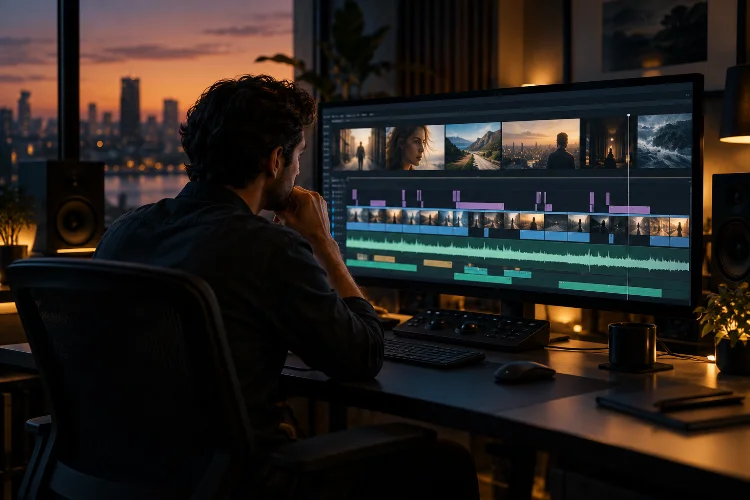
Great editing is often invisible. Viewers rarely sit there thinking about exactly how many seconds a shot lasts or why an editor cut from one angle to another at a particular moment. They simply feel that a scene is tense, energetic, emotional, calm, or uncomfortable.
That reaction is strongly influenced by editing rhythm.
Rhythm determines how images, performances, dialogue, movement, music, and sound unfold over time. An editor can accelerate a sequence by shortening shots, allow an emotional moment to breathe by holding a frame longer, or create anticipation simply by delaying a cut.
StudioBinder explains that pacing is closely connected to editing rhythm and that changing shot duration can increase intensity or create moments of calm.
For professional video projects, this matters far beyond feature films. Commercials, documentaries, corporate films, branded content, interviews, and social videos all rely on rhythm to shape how audiences experience information.
Good editing does not just organize footage. It controls when viewers feel something.
Editing Rhythm Is More Than Cutting Fast or Slow
Editing rhythm is sometimes reduced to one simple idea: short shots feel fast and long shots feel slow.
That is partly true, but rhythm is more complicated.
Editors are also responding to dialogue, body movement, facial expressions, music, sound effects, camera movement, and the emotional direction of the scene.
A five-second shot can feel extremely short during a quiet conversation but painfully long during a rapid action sequence.
Context changes perception.
StudioBinder notes that editors create rhythm partly by establishing an expected pace and then deliberately changing it. Shortening shots can increase intensity, while longer shots can provide relief or emotional space.
This means professional editing should not follow a fixed rule such as “cut every three seconds.”
The right cut happens when the emotional and narrative moment is ready.
Shot Duration Directly Changes Emotional Intensity
One of the editor’s most basic tools is simply deciding how long to stay on an image.
Longer shots give audiences time to observe.
They can notice expressions, environments, subtle gestures, and changes in performance. This often works well for emotional interviews, dramatic scenes, luxury content, documentaries, or moments designed to feel thoughtful.
Shorter shots create a different psychological experience.
Information arrives faster.
The audience has less time to process each image before the next one appears, creating urgency, excitement, pressure, or sometimes confusion.
The famous shower sequence in Psycho is often studied because its rapidly changing rhythm increases intensity without relying on explicit visual detail.
StudioBinder specifically highlights the contrast between longer and shorter shots as a key reason the sequence remains emotionally effective.
The important lesson is not that fast cutting creates better tension.
It is that changing rhythm creates contrast.
Emotional Moments Often Need Time to Breathe
Professional editors sometimes cut too quickly because they are afraid audiences will become bored.
But emotional moments require processing time.
Imagine an interview subject revealing something deeply personal.
The person finishes speaking and becomes silent.
An inexperienced edit might immediately cut to B-roll because “nothing is happening.”
Yet something is happening.
The pause itself contains emotion.
The person’s expression changes. They may look away, breathe, or hesitate before continuing.
Walter Murch’s influential Rule of Six places emotion above story, rhythm, eye trace, screen direction, and spatial continuity when judging an edit. The underlying principle is that audience feeling should guide the cut.
Sometimes the strongest editing decision is simply waiting.
Giving a reaction another second can create more emotional impact than adding music, transitions, or complicated visual effects.
Faster Rhythm Can Build Energy and Urgency
Shorter shot duration becomes useful when the story needs momentum.
Sports films, event videos, product launches, action sequences, promotional campaigns, and social content often use faster rhythms to increase energy.
Consider a commercial showing a busy restaurant during dinner service.
The edit might jump between knives chopping ingredients, flames rising, plates moving across counters, servers rushing through the kitchen, and customers reacting to the food.
Individually, these actions are relatively ordinary.
Cut together rapidly, they create momentum.
Sound can intensify the effect.
Knife impacts, footsteps, sizzling pans, short music beats, and fast visual cuts combine into a rhythmic pattern.
This creates intensitiy without requiring every individual shot to contain dramatic action.
Editors essentially build energy from accumulation.
The audience feels speed because visual and audio information keeps arriving before the previous moment has completely settled.
Rhythm Should Follow Performance
Dialogue scenes demonstrate why editing rhythm cannot be based only on technical timing.
Actors create their own rhythm.
They pause, interrupt, hesitate, breathe, react, and change expressions.
The editor needs to recognize that internal performance timing.
Cutting immediately after every spoken sentence often creates mechanical editing.
Sometimes the more interesting moment occurs before the dialogue begins or several seconds after it ends.
Walter Murch’s editing philosophy prioritizes emotion and story before purely technical continuity, encouraging editors to consider whether the cut feels emotionally correct rather than simply maintaining perfect spatial logic.
This principle applies to professional interviews too.
Instead of always cutting to the person speaking, an editor might stay on someone listening.
A small smile, uncomfortable pause, or surprised reaction can communicate more than the dialogue itself.
Editing rhythm therefore grows partly from human behavior.
The cut should listen to the performance.
Music Creates a Rhythm, but Editors Should Not Become Trapped by It
Music gives editors an obvious timing structure.
Beats, percussion, transitions, crescendos, and pauses offer natural places to cut.
Matching edits with music can feel satisfying, particularly in commercials, sports videos, travel content, event films, and promotional sequences.
But cutting on every beat quickly becomes predictable.
Strong editors vary the relationship between image and music.
Some shots land directly on major beats. Others stretch across several beats. Occasionally, a visual change may happen slightly before or after the musical accent.
That variation prevents the video from feeling like a slideshow synchronized mechanically to a soundtrack.
Director Mira Nair describes rhythm and juxtaposition as tools that can alter a film’s mood, reinforcing the importance of treating editing as something closer to musical composition than simple assembly.
Music should influence the edit.
It should not control every decision.
Sound Can Create Rhythm Without Visible Cuts
Editing rhythm is not purely visual.
Sound can dramatically change how fast or slow a sequence feels.
Imagine a slow shot of an athlete preparing for a race.
Visually, almost nothing happens.
But the soundtrack contains breathing, shoes hitting the ground, distant crowd noise, a heartbeat, and a gradually accelerating musical pulse.
The sequence begins to feel faster even though the camera barely moves.
Editors can also carry sound across cuts.
A machine starts running in one shot, but its sound continues underneath the next image. Dialogue begins before the corresponding speaker appears. Music disappears suddenly while the picture continues.
These choices create continuty between otherwise separate images.
Adobe’s editing guidance emphasizes that editing decisions affect emotion, pacing, and narrative clarity rather than simply determining where one clip ends and another begins.
Professional editors therefore often think in two overlapping rhythms: picture and sound.
The relationship between them can dramatically affect emotion.
Breaking an Established Rhythm Creates Impact
Once audiences become accustomed to a particular editing rhythm, changing it becomes powerful.
Imagine a fast-paced recruitment video.
Employees move between meetings, workshops, laboratories, and social spaces. The edit remains energetic for almost a minute.
Then everything stops.
The music disappears.
A single employee sits quietly and explains why a particular project mattered personally.
The sudden decrease in pace makes the moment feel important because it breaks the established rhythm.
The opposite technique works too.
A documentary may begin with calm interviews and patient observational shots. When a crisis occurs, cutting suddenly becomes faster and less predictable.
The rhythm communicates the change before viewers fully process the narrative details.
This is why editing should rarely maintain exactly the same tempo throughout an entire production.
Contrast gives rhythm meaning.
Without variation, even an energetic editing style eventually starts to feel flat.
Camera Movement and Editing Rhythm Need to Work Together
The movement inside shots also affects when cuts feel natural.
A fast tracking shot has internal momentum.
Cutting from it into a completely static composition may intentionally create contrast, but doing so accidentally can feel awkward.
Editors often look for movement that connects shots.
A person moves left across one frame and continues moving in a similar direction after the cut. A camera push-in transitions into a closer shot. A hand reaching toward an object provides movement that carries viewers through the edit.
This creates visual flow.
However, movement does not always need to match perfectly.
Sometimes disrupting flow is exactly the point.
An intense handheld sequence might suddenly cut to a static wide shot to emphasize shock or isolation.
Editing rhythm should therefore respond not only to how long shots last but to how much internal energy they contain.
Different Professional Videos Need Different Rhythms
There is no universal editing tempo that makes video look professional.
A luxury watch film may rely on long macro shots, slow movement, and carefully controlled transitions.
A sports campaign might require rapid montage and aggressive sound design.
A documentary interview may need pauses and subtle reactions.
A technology explainer could benefit from a balanced pace that gives audiences enough time to understand complex information without losing momentum.
The desired audience also matters.
Someone watching an educational video needs time to process information. Someone watching a 20-second campaign teaser may expect information much faster.
This is why editing rhythm should be developed from the project’s purpose rather than copied from whatever visual style is currently popular.
Professional editing is not about making every project fast.
It is about finding the pace that makes the content emotionally and narratively effective.
Eye Trace Helps Fast Editing Stay Understandable
Rapid editing can become confusing if viewers have to constantly search for the subject after each cut.
This is where eye trace becomes useful.
Walter Murch’s Rule of Six identifies eye trace as the relationship between the viewer’s point of attention in one frame and where their attention needs to move after the cut.
For example, if someone’s face is positioned near the right side of one frame, cutting to another important detail near the same area can make the transition easier to process.
This matters especially during fast sequences.
The editor can increase pacing without completely overwhelming viewers.
A chaotic edit may be intentional in some projects, but professional rhythm usually depends on balancing speed with comprehension.
Energy means little if audiences cannot understand what they are seeing.
Rhythm Should Evolve Across the Entire Video
Editors should think beyond individual scenes.
Every sequence contributes to the larger emotional shape of the project.
A 90-second brand film might begin slowly, accelerate as the company introduces its capabilities, reach maximum energy during a product montage, then slow down again for the final message.
That creates an emotional curve.
If every section moves at maximum speed, the audience has nowhere to go emotionally.
Similarly, if every shot is long and contemplative, important moments may fail to stand out.
Professional editors manage rythm across multiple levels: individual cuts, scenes, sequences, and the entire production.
Murch’s approach similarly treats rhythm as one component of a larger hierarchy that ultimately serves emotion and story.
The strongest edits feel intentional not only from shot to shot, but from beginning to end.
Editing rhythm shapes emotion across professional video projects because timing determines how audiences experience every image, performance, sound, and piece of information.
Shorter shots can increase urgency, longer takes create emotional space, music can establish momentum, and silence can completely change the meaning of a sequence.
The goal is not simply to make editing faster or smoother.
It is to create the right emotional timing.
When editing your next professional video, pay attention to how each scene feels rather than only whether the cuts are technically clean.
Experiment with holding reactions longer, shortening shots during moments of intensity, changing rhythm between sections, and allowing silence to breathe. When rhythm follows emotion and story, viewers stop noticing the editing – and start feeling the experience.
