


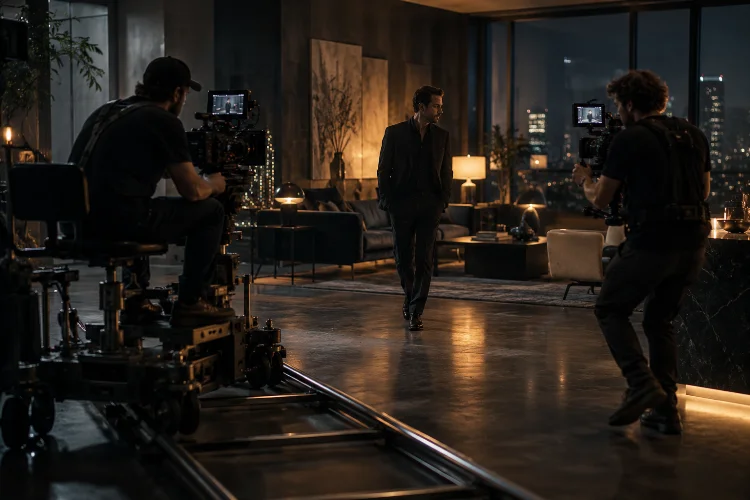
Two cameras can follow the same actor through the same room and create completely different emotions. The difference might have nothing to do with lenses, lighting, performance, or editing. Sometimes, it comes down to how the camera itself moves.
A dolly gliding smoothly toward a subject can feel deliberate, elegant, intimate, or even ominous. A handheld camera following that same subject can feel immediate, unstable, personal, or unpredictable.
That distinction explains why dolly movement creates different emotion than handheld footage.
StudioBinder describes dolly shots as smooth, controlled movements that can bring audiences emotionally closer to a character or create distance by moving away.
Handheld photography works differently because the operator’s physical movement introduces natural camera shake and irregularity.
Neither technique is inherently more cinematic than the other. They simply communicate different psychological signals.
Understanding those signals allows filmmakers to choose movement because it supports the story – not simply because the equipment is available.
Dolly Movement Feels Controlled and Intentional
A traditional dolly places the camera on a wheeled platform, often moving along carefully positioned track.
That mechanical stability creates one of its defining characteristics: precision.
StudioBinder describes dolly shots as movements designed to provide smooth, controlled camera motion. They can move toward, away from, alongside, or around a subject while maintaining a consistent visual path.
Emotionally, this control can make a scene feel deliberate.
Imagine a luxury hotel advertisement. A slow dolly moving through an elegant lobby communicates calmness, sophistication, and confidence because nothing in the frame feels accidental.
The same movement could communicate something very different in a thriller.
A slow push toward a character sitting alone in a dark room can create tension precisely because the movement is so controlled. The audience senses that something important is approaching even though the visual movement remains subtle.
Smoothness does not automatically mean relaxation.
Context determines the final emotion.
Handheld Footage Feels More Human and Immediate
Handheld footage contains small movements created by the camera operator’s body.
Even when the operator is highly skilled, breathing, footsteps, balance changes, and physical reactions introduce subtle irregularities.
That imperfection can make images feel human.
StudioBinder notes that handheld photography can produce psychological effects ranging from panic and chaos to intimacy.
The technique has been used in both intense action scenes and quiet character moments because its movement feels physically connected to the person operating the camera.
Consider a documentary following emergency workers through a crowded environment.
Perfectly smooth movement might make the sequence visually attractive, but controlled handheld photography can make viewers feel physically present.
The camera reacts.
It adjusts.
It seems to search for information in the same way a person might.
That creates a sense of immediacey that smooth mechanical motion often does not produce naturally.
A Dolly Push Can Intensify Emotional Connection
One of the most powerful dolly techniques is also one of the simplest: slowly moving toward someone.
As the camera gets physically closer, the subject gradually occupies more of the frame.
That changing proximity can strengthen emotional connection.
StudioBinder explains that dollying toward a subject can emphasize dialogue, emotion, or a moment of realization. A dolly-in can effectively make viewers feel physically and emotionally closer to the character.
Imagine an interview subject discussing the early stages of building a company.
The camera begins in a medium shot.
When the speaker starts discussing a major personal failure, the dolly quietly begins moving forward. By the end of the statement, viewers are significantly closer.
They may barely notice the movement technically.
Emotionally, however, the shot has become more intimate.
Because the move follows a predictable path, it can feel like the story itself is drawing viewers closer rather than the camera operator physically reacting.
Handheld Intimacy Feels More Personal
Handheld footage can also create intimacy, but it tends to feel different.
A dolly push often creates carefully designed intimacy.
Handheld imagery can create observational intimacy.
The subtle camera drift makes viewers feel as though another person is physically standing inside the scene with the subject.
This approach is common in documentaries, behind-the-scenes films, interviews, and character-driven narratives.
A camera operator may respond slightly to gestures, reposition when a subject moves, or make tiny framing corrections in real time.
Those movements can become part of the emotional language.
The audience is no longer watching from a perfectly engineered platform. They feel like they are sharing the same physical space.
That distinction can be useful in branded content too.
A polished dolly sequence might present a CEO as authoritative and composed, while a lightly handheld interview could make the same executive feel more accessible and spontaneous.
Handheld Movement Can Increase Tension and Uncertainty
Visual instability naturally creates uncertainty.
When the frame does not remain perfectly fixed, audiences cannot entirely predict where the camera will move next.
Filmmakers frequently use this characteristic during action, conflict, disaster, or emotionally unstable moments.
StudioBinder points to the opening battle sequence of Saving Private Ryan as an example of handheld photography used to support panic and chaos.
The camera does not calmly observe the action.
It appears trapped inside it.
That psychological difference matters.
Imagine filming someone running down a corridor.
A smooth dolly moving backward at exactly the same speed might make the sequence feel carefully choreographed.
A handheld operator retreating in front of the character can introduce small shakes and framing variations that communicate danger or urgency.
The action itself has not changed.
The camera’s relationship to the action has.
Dolly Movement Can Create Emotional Distance
Dollies are not only useful for moving closer.
Moving away from a character can communicate separation, isolation, or revelation.
StudioBinder notes that dollying away can create both physical and emotional distance while also revealing more of the environment around a subject.
Imagine a worker receiving bad news in a quiet factory.
The shot begins relatively close.
As the character processes what happened, the camera slowly moves backward, revealing the enormous empty space surrounding them.
The movement changes the emotional meaning of the environment.
What previously looked like a workplace now reinforces loneliness.
A handheld operator walking backward could capture similar framing, but the small physical irregularities would create a different feeling.
The dolly’s steady retreat feels almost inevitable.
That precision can make emotional separation feel more deliberatly constructed and therefore more dramatic.
Handheld Footage Suggests Subjectivity
Handheld camera work can feel connected to a character’s perspective even when the shot is not literally a point-of-view angle.
Its physical instability resembles the way human beings experience environments while moving.
We do not glide perfectly through space.
Our bodies shift, turn, stop, and correct themselves.
Because of this, handheld footage can create subjectivity.
A nervous character entering an unfamiliar building might be followed with slightly unstable camera movement. Viewers begin to share some of that uncertainty because the frame itself does not feel fully settled.
A smooth dolly following the same character would communicate something different.
The movement might make the situation feel predetermined, elegant, or observational rather than personally unstable.
Filmmakers can therefore use camera support as part of characterization.
Sometimes the emotional state is communicated not only through acting but through the physical behavior of the camera.
Smoothness Changes the Audience’s Awareness of Technique
Good dolly movement can become nearly invisible.
When speed is controlled and track movement is smooth, viewers may experience the emotional effect without consciously thinking about the equipment.
This can be extremely valuable.
StudioBinder’s dolly guidance explains that subtle pushes can increase connection with a subject without calling attention to themselves.
Handheld footage is often more noticeable because the frame continuously contains micro-movements.
That does not make it worse.
It simply means viewers are more likely to feel the physical presence of the camera.
This difference affects how polished a production feels.
Commercials, luxury videos, architecture films, and premium corporate content often use controlled movement because the smoothness communicates precision.
Documentaries, sports films, behind-the-scenes projects, and emotionally intense narratives may deliberately preserve more camera movement because that instability supports authenticity.
The choice becomes part of the production’s visual identity.
Movement Speed Changes Both Techniques
Equipment alone does not determine emotion.
Speed matters enormously.
A slow dolly push can create intimacy or tension. A rapid dolly move can produce energy and dramatic emphasis.
The same applies to handheld work.
Slow handheld movement with subtle camera shake may feel intimate and observational. Aggressive handheld movement can create confusion, urgency, or chaos.
StudioBinder’s broader camera movement guidance emphasizes that different movements serve different storytelling functions, including controlled dolly motion, push-ins for emphasis, tracking for engagement, and static shots for stillness.
This is why labels such as “dolly equals calm” and “handheld equals chaos” are too simplistic.
Filmmakers need to consider movement direction, speed, framing, lens choice, blocking, sound, and editing together.
A camera technique gains emotional meaning from the context surrounding it.
Dolly Zooms Show How Movement Can Manipulate Psychology
The emotional power of dolly movement becomes particularly obvious with the dolly zoom.
A dolly zoom combines physical camera movement in one direction with a lens zoom moving in the opposite direction.
The subject can remain roughly the same size while the background appears to stretch or compress.
Adobe explains that this technique can distort perspective, show emotional change, and heighten tension.
StudioBinder similarly connects the technique with psychological states including paranoia, conflict, disorientation, and intimacy.
This demonstrates an important principle.
Movement is not just about following subjects.
Changing camera position changes perspective, spatial relationships, and therefore the viewer’s emotional interpretation of a scene.
Professional cinematography uses these changes intentionally.
Combining Dolly and Handheld Can Strengthen a Story
A production does not need to choose one style for everything.
Sometimes the strongest approach is contrast.
Imagine a corporate documentary beginning with polished dolly shots of a successful company headquarters. Everything feels structured, stable, and controlled.
Later, employees describe a crisis that nearly destroyed the business.
The visual language changes to closer handheld footage.
That transition immediately alters the emotional atmosphere.
When the story eventually returns to stability, smooth movement can return.
The camera style becomes part of the narrative arc.
This approach is often more effective than using constant motion simply to make footage look cinematic.
If everything is smooth, smoothness loses meaning.
If everything is unstable, instability becomes normal.
Contrast creates visual diferentiation.
Choosing Between Dolly and Handheld Should Start With Emotion
Filmmakers sometimes choose camera movement based on convenience.
The production owns a gimbal, so everything becomes stabilized. A small crew lacks track, so every scene becomes handheld.
Practical limitations matter, but emotion should ideally come first.
Ask what the audience should feel.
Should the scene feel elegant or immediate? Controlled or unpredictable? Observational or intimate? Stable or emotionally unstable?
Then choose the movement strategy.
Modern equipment provides alternatives too. Sliders can produce short controlled moves, while gimbals can create smooth tracking without traditional track.
StudioBinder notes that sliders can function as compact alternatives to dollies and that stabilizers can create smooth camera motion in more flexible environments.
Technology changes.
The storytelling question remains the same.
Dolly movement creates a different emotion than handheld footage because audiences respond not only to what the camera sees, but also to how the camera behaves.
Dolly shots offer precision, smoothness, emotional control, and deliberate perspective changes. Handheld footage introduces physical irregularity that can make scenes feel immediate, intimate, subjective, or unstable.
Neither approach is universally better.
The strongest cinematography chooses movement based on the emotional purpose of the scene.
Before your next production, avoid asking only which camera rig looks more professional. Ask how viewers should feel when they enter the scene.
Once that emotional goal is clear, deciding between a controlled dolly move and organic handheld photography becomes much easier – and much more meaningful.
