


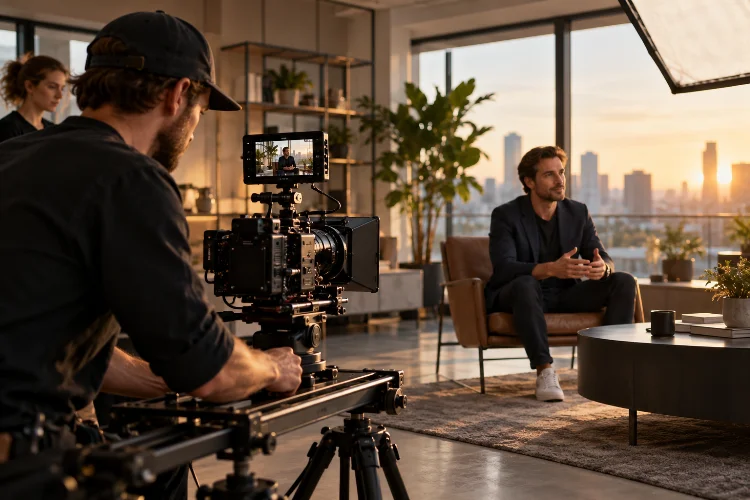
A camera does not need to move simply because modern equipment makes movement easy. In professional video, the more important question is why the camera should move at all.
A slow push toward a speaker can make a moment feel more important.
Following someone through a workspace can make viewers feel as though they are entering that environment themselves. A controlled pullback can suddenly reveal scale, isolation, or information that was previously hidden.
This is where controlled camera movement becomes part of visual storytelling rather than just a technical trick.
Adobe notes that movement-based shots such as tracking and dolly shots can influence story pace, emotional depth, and spatial orientation. The best filmmakers therefore treat movement almost like dialogue: every move should communicate something.
Whether a professional production uses a tripod head, dolly, slider, gimbal, Steadicam, crane, or handheld rig, meaningful movement starts with creative intention. When that intention is clear, even a very simple camera move can transform how an audience experiences a scene.
Camera Movement Directs the Viewer’s Attention
Every frame contains visual information competing for attention.
Camera movement allows filmmakers to decide what viewers notice and when they notice it.
Imagine a corporate video showing a designer working in a large studio. A static wide shot might simply establish the room.
A slow tracking movement toward the designer gradually shifts attention from the environment to the person, making the individual increasingly important within the frame.
Movement can also reveal information.
A lateral camera move might begin on a product prototype and then reveal the engineering team working behind it. Instead of showing both elements immediately, the camera controls the order in which viewers understand the scene.
This makes movement a form of visual editing inside the shot.
The audience is not merely looking at an image. They are being guided through it.
Push-Ins Can Increase Emotional Importance
One of the simplest movements in professional cinematography is the push-in.
The camera physically moves toward the subject, often slowly enough that viewers barely notice the movement consciously.
Yet the psychological effect can be powerful.
StudioBinder explains that dolly movements toward a character can emphasize dialogue, emotion, or a moment of realization.
Imagine an interview in which a founder talks casually about starting a company. The camera remains relatively wide. When the conversation moves toward a deeply personal failure that nearly ended the business, the camera begins a subtle push forward.
The frame becomes more intimate as the story becomes more personal.
The movement reinforces what is already happening emotionally.
This is very different from moving the camera just because the crew has access to a slider or dolly.
The storytelling intension should come first.
Pullbacks Can Reveal Context and Change Meaning
Moving away from a subject can be equally effective.
A pullback often changes how audiences understand the relationship between a person and their environment.
Consider a documentary opening with a close shot of a scientist examining something through a microscope. Slowly pulling backward could reveal a huge laboratory filled with researchers and advanced equipment.
The meaning expands from one person’s action to an entire scientific operation.
A pullback can also create emotional distance.
StudioBinder notes that dollying away can reveal the surrounding environment or create a sense of emotional separation.
This technique works particularly well when the environment itself contributes to the message.
In a sustainability video, for example, pulling away from a worker to reveal a massive renewable-energy facility immediately communicates scale without requiring narration.
One controlled move can replace several explanatory sentences.
Tracking Shots Create Immersion and Momentum
Tracking shots physically move through a location or alongside a subject.
This can make viewers feel less like distant observers and more like participants.
Adobe describes tracking shots as movements that follow action and can immerse audiences, reveal information, introduce characters, or communicate emotion.
StudioBinder similarly notes that tracking shots can create excitement, maintain continuity, and place viewers inside the action.
That makes them extremely useful in professional video.
A manufacturing film might follow a component through several production stages. A hospitality video could move behind a chef through a busy kitchen.
A recruitment film might follow an employee through different departments rather than cutting between disconnected office shots.
Movement creates continuity between spaces.
Instead of showing viewers where someone works, the video allows them to experience the journey.
That sense of physical progression can make even ordinary environments feel more engaging.
Lateral Movement Can Show Relationships Between Subjects
Not every camera move needs to approach or follow someone.
Sideways movement can be excellent for showing relationships between people, products, or environments.
Imagine three engineers standing beside different stages of a prototype.
A lateral tracking shot can move smoothly from one engineer to another while keeping their shared environment visible. The audience understands that these individuals are part of one connected process.
This creates visual seperation when necessary while still preserving spatial continuity.
Lateral movement is also useful for walk-and-talk sequences.
Instead of placing the camera directly in front of two people, the camera can travel beside them. The resulting composition often feels natural because audiences can observe both the conversation and the changing environment.
StudioBinder identifies lateral tracking as a common approach for walk-and-talk scenes, where the camera moves alongside the subjects.
Used carefully, this technique can make informational content feel much more cinematic without distracting from what is being said.
Camera Speed Changes the Emotional Tone
The direction of camera movement matters, but speed matters just as much.
A slow camera move usually feels deliberate.
It can suggest confidence, curiosity, intimacy, tension, or elegance depending on the scene.
Fast movement creates a completely different energy.
A rapid tracking shot might increase urgency. A whip pan can create surprise or connect two subjects with sudden visual energy.
StudioBinder’s camera movement resources distinguish between controlled techniques such as dolly moves and faster techniques such as whip pans, each carrying different storytelling possibilities.
Professional filmmakers therefore think about movement speed in relation to the overall rhythm of the video.
A luxury brand film may use slow, precise movement to communicate refinement.
A sports campaign may use faster movement to create intensity.
The equipment could be identical. The emotional effect comes from how it is operated.
Stable and Handheld Movement Communicate Different Feelings
Perfectly smooth movement is not always the correct choice.
Dollies, gimbals, sliders, and stabilized rigs generally create controlled motion, while handheld cameras introduce small natural variations.
Those differences communicate different visual personalities.
Smooth movement can feel polished, observational, premium, or carefully designed.
Handheld footage may feel immediate, spontaneous, intimate, or documentary-like.
Neither style is automatically better.
The right choice depends on the story.
A polished automotive commercial might benefit from extremely smooth tracking shots around a vehicle. A behind-the-scenes documentary about the engineers who designed it might feel more genuine with controlled handheld photography.
The key word is controlled.
Handheld does not have to mean random shaking. Professional operators intentionally manage body position, lens choice, distance, and movement rhythm to create a specific degree of instability.
Visual consistancy matters more than simply making every shot perfectly smooth.
Camera Movement Can Reveal Space Gradually
Professional videos frequently need to introduce locations.
The obvious solution is an establishing wide shot.
But camera movement can reveal the environment more dynamically.
A tracking shot might begin behind a foreground object, follow a person through a doorway, and gradually expose an entire production floor.
Adobe notes that tracking shots can establish locations and create seamless transitions between environments while maintaining the viewer’s connection with a character.
This technique is particularly effective for architecture, hospitality, real estate, manufacturing, tourism, and corporate environments.
Instead of saying, “Our facility contains several specialized departments,” the camera can physically travel between those spaces.
Movement transforms geography into storytelling.
Viewers understand how different areas relate because they experience the spatial connection themselves.
Movement Needs to Be Planned During Preproduction
Complicated camera movement should rarely be invented at the last second.
Tracking shots may affect blocking, lighting, focus, sound, production design, grip equipment, and crew positioning.
The longer the move, the more departments must coordinate.
Adobe recommends planning movement carefully, using appropriate stabilization equipment, and rehearsing with performers before capturing complex tracking shots.
Storyboards and shot lists are especially valuable.
StudioBinder recommends documenting camera movement directly in storyboards using clear movement terminology and visual arrows. Its shot-list guidance similarly identifies movement categories such as pan, tilt, pedestal, dolly, truck, arc, Steadicam, and handheld.
This preparation improves coordiantion.
A gaffer knows where the camera will travel. Actors understand their marks. Focus pullers can anticipate distance changes, while grip teams know what track, stabilization, or support needs to be prepared.
The smoother the planning, the more invisible the technical complexity becomes on screen.
Too Much Movement Can Weaken the Message
One of the biggest mistakes in modern video production is moving the camera constantly.
Gimbals and compact stabilization systems make motion easier than ever, but technical possibility does not equal storytelling necessity.
If every shot circles, pushes, slides, tilts, or floats, movement loses its impact.
Static shots provide contrast.
Stillness can communicate confidence, tension, seriousness, simplicity, or stability. When movement eventually begins, audiences notice the change even if they cannot explain why.
A CEO delivering an important statement might be stronger in a locked frame than in a constantly orbiting gimbal shot.
Then, when the video transitions into the company’s active production environment, tracking movement can introduce momentum.
The contrast gives each visual choice meaning.
Good cinematography is therefore not about maximizing movement. It is about choosing when movement adds information or emotion that a static frame cannot provide as effectively.
Controlled Movement Should Support Editing
Camera movement also needs to work with the final edit.
A shot that begins moving usually needs enough usable time before and after the movement for an editor to cut naturally.
Matching direction between shots can also preserve visual flow.
If one shot tracks strongly from left to right and the next suddenly moves in the opposite direction without motivation, the transition may feel awkward.
Movement can also become a transition itself.
A pan ending on a dark foreground object could cut seamlessly into another shot beginning behind something similar. Matching camera speed between scenes may create a smooth visual connection between completely different locations.
Thinking about the edit during production prevents camera movement from becoming isolated visual decoration.
Each move becomes part of a larger rhythm.
Controlled camera movement adds meaning to professional video when every move serves a clear purpose.
Push-ins can increase intimacy, pullbacks reveal context, tracking shots create immersion, lateral moves connect subjects, and changes in speed can reshape the emotional tone of a scene.
The equipment is only the mechanism. Meaning comes from intention.
Before adding a dolly, gimbal, slider, crane, or handheld move to your next production, ask what the audience should feel or understand differently because the camera moves. If there is no strong answer, a static shot may actually be more effective.
Plan movement during preproduction, rehearse complicated shots, and use motion selectively. When camera movement supports the story rather than competes with it, professional video becomes more immersive, precise, and memorable.
