


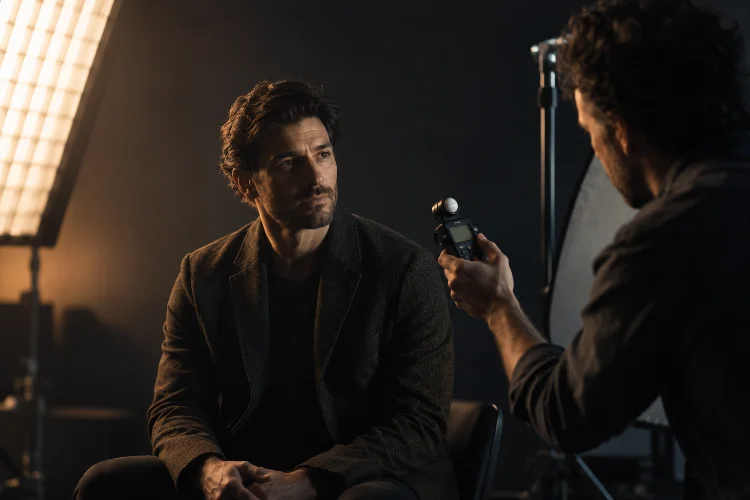
Beautiful cinematic lighting is not simply about using expensive fixtures or making every frame bright enough. Much of what makes an image feel polished comes from the relationship between light and shadow.
That relationship can be described through lighting ratios.
In practical terms, a lighting ratio compares brightness levels within a scene, most commonly between the illuminated and shadow sides of a subject.
A lower ratio produces softer contrast, while a higher ratio creates deeper shadows and more dramatic separation. StudioBinder notes that the strength of fill light is a major factor in determining contrast, depth, and the overall mood of a shot.
For advanced cinematic video production, understanding these ratios gives cinematographers something more useful than simply saying, “Make it moodier.”
They can deliberately control how much detail remains in shadows, how faces are modeled, and how consistently a visual style survives across different cameras, locations, and shooting days.
Lighting Ratios Explain the Relationship Between Key and Fill
Most lighting ratios begin with two important ideas: key light and fill light.
The key is the primary shaping source. It establishes direction and usually creates the strongest illumination on the subject.
Fill reduces the shadows created by that key.
How strong the fill becomes in relation to the key determines much of the image’s contrast. StudioBinder describes fill intensity as one of the main factors controlling shadows, depth, and lighting style.
A relatively balanced relationship produces softer facial shadows.
Reduce the fill significantly and one side of the face becomes much darker.
That may sound like a small technical adjustment, but visually it can transform the scene from friendly and commercial to mysterious and dramatic.
Lighting ratios give cinematographers a repeatable way to describe that transformation.
Low Ratios Produce Softer, More Open Images
When key and fill levels are relatively close, shadows remain visible but gentle.
StudioBinder gives roughly 2:1 as an example of a softer lighting relationship, while its three-point lighting guide suggests lower ratios for inviting commercial or corporate imagery.
This style often works well for interviews, beauty content, lifestyle advertising, comedy, corporate videos, and scenes designed to feel optimistic.
Imagine filming a company founder discussing future growth.
A soft key combined with generous fill keeps both sides of the face readable. The result feels open and approachable.
That does not mean low ratios automatically create boring images.
Direction, color, background exposure, lens choice, and production design can still add depth.
The ratio simply determines how aggressively shadows shape the subject.
Higher Ratios Create Stronger Drama
Increasing the difference between key and fill produces deeper shadows.
An 8:1-style relationship is commonly associated with higher-contrast, low-key lighting, where shadows become much more prominent.
StudioBinder and Filmmakers Academy both connect these stronger ratios with dramatic visual styles and moods such as mystery, tension, seriousness, and psychological depth.
Imagine the same executive interview from the previous example.
Now reduce the fill significantly.
Half of the face becomes darker, the cheekbones appear more defined, and the overall image immediately feels more serious.
Nothing about the performance has changed.
The lighting has changed the emotional interpretation.
This is why cinematographers treat ratio as a storytelling choice rather than merely a technical measurement.
Stops Provide a Practical Way to Understand Contrast
Lighting ratios become easier to understand when connected to stops.
Each full stop represents a doubling or halving of light.
For example, two stops of difference correspond to a 4:1 brightness relationship when comparing light levels directly. Three stops correspond to 8:1.
This makes exposure meters extremely useful.
Instead of relying completely on a monitor, a cinematographer can measure the brighter side of a face and compare it with the shadow side.
Suppose the key side reads f/4 while the shadow side reads two stops lower.
That immediately communicates a specific contrast relationship that can be recreated later.
Meters are especially helpful on productions where visual consistancy must survive multiple sets or shooting days.
Lighting Ratios Shape Faces
One of the most important applications of lighting ratios is facial modeling.
A face is three-dimensional.
If both sides receive almost identical illumination, facial structure can appear flatter.
Reduce the fill and features such as cheekbones, jawlines, noses, and eye sockets become more pronounced.
This does not mean more contrast always looks better.
Beauty advertising may intentionally use soft, low-ratio illumination because smooth tonal transitions are flattering.
A dramatic character portrait might benefit from deeper shadows.
The correct choice depends on who the subject is and what the production wants audiences to feel.
Different faces, skin tones, wardrobe, makeup, and environments can also react differently to the same setup.
Professional cinematography therefore treats lighting ratios as a starting point rather than a rigid formula.
High-Key and Low-Key Lighting Depend Heavily on Ratios
High-key and low-key lighting are sometimes misunderstood as simply “bright” and “dark.”
The real distinction is largely about contrast.
High-key images generally use stronger fill and therefore lower lighting ratios, keeping shadows relatively soft. Low-key imagery uses less fill, producing stronger contrast and larger areas of shadow.
A low-key scene does not necessarily need to be underexposed.
The highlights can remain properly exposed while the shadow areas intentionally fall much darker.
Likewise, high-key does not mean simply increasing overall exposure.
The relationship between bright and dark areas matters more.
This distinction is essential in cinematic production because exposure and contrast are related but different creative controls.
Negative Fill Can Increase the Ratio Without Adding Another Light
Cinematographers do not always need another fixture to modify contrast.
Sometimes they need less light.
Negative fill uses black fabric, flags, solids, or other dark surfaces to absorb ambient illumination from the shadow side of a subject.
Filmmakers Academy notes that negative fill is often used in low-key setups to deepen shadows and increase contrast.
This is especially helpful in naturally bright locations.
Imagine filming beside a large window in a white room.
The window creates a beautiful directional key, but light bouncing from white walls fills the opposite side of the face too much.
Placing a black flag near the subject removes part of that bounce.
Suddenly the face gains shape without adding another powered fixture.
Sometimes subtracting light is more effective than adding it.
Ratios Help Preserve Shadow Detail
Modern cameras offer impressive dynamic range, but that does not mean cinematographers should ignore shadow exposure.
Very high contrast can push shadow regions into areas where texture becomes difficult to recover cleanly.
Lighting ratios help crews make these decisions intentionally.
Rather than simply judging whether an image “looks dark enough,” cinematographers can determine how far they want shadows to fall below the key exposure.
This becomes especially important when footage will undergo substantial color grading.
Keeping usable shadow information provides flexibility.
Crushing blacks during grading is often easier than recovering detail that was never captured properly.
The aim is not always to preserve every shadow.
It is to decide deliberately what information should remain visible.
Ratios Improve Continuity Across Coverage
Dialogue scenes often require wide shots, medium shots, close-ups, and reverse angles.
Lighting equipment may need to move substantially between setups.
Yet the final sequence should feel as though everything happened at the same moment.
Lighting ratios provide a useful continuity reference.
Suppose a wide shot establishes a moderate contrast relationship across an actor’s face.
When the camera moves in for the close-up, the cinematographer can soften the key, reposition fixtures, or use larger diffusion.
As long as the overall balance remains similar, the shot still belongs visually to the same scene.
Without that reference, close-ups can suddenly become much flatter or more contrasty than wider coverage.
This inconsistancy becomes obvious once the shots are edited together.
Background Ratios Matter Too
Advanced lighting design does not stop at the face.
The brightness relationship between the subject and background also influences depth.
If the person and background have very similar exposure, separation can decrease.
Darkening the background relative to the subject may draw attention toward the face.
Alternatively, placing a darker subject against a brighter environment can create silhouette or graphic separation.
Lighting ratios can therefore describe relationships across the entire frame, not merely key versus fill.
Consider an executive interview.
The face might be correctly exposed, while the office behind them sits approximately one or two stops darker.
The viewer’s attention naturally stays on the speaker.
In another project, a bright architectural background may be central to the story, so the relationship changes.
Ratios help cinematographers design visual hierarchy.
Consistent Ratios Help Multi-Day Productions
Maintaining a cinematic look becomes harder when production lasts several days.
Natural light changes.
Locations change.
Fixtures move.
Different crew members may adjust equipment.
Documenting lighting relationships gives the cinematography team a stronger reference when recreating scenes.
A light meter reading, lighting diagram, camera settings, reference still, and ratio notes can help reconstruct a setup days later.
This is particularly valuable for interviews filmed across multiple locations.
If every subject should share a similar visual style, controlling ratios helps keep the project coherent even when room size, wall color, and ambient light are completely different.
Professionalism often comes from this kind of repeatability rather than from expensive equipment alone.
Ratios Should Support Story Before Mathematics
Lighting ratios are useful numbers, but cinematography is not a spreadsheet.
A 4:1 ratio is not automatically cinematic.
An 8:1 ratio is not automatically dramatic.
StudioBinder’s lighting guidance emphasizes that the relationship between key, fill, shadow, and mood should ultimately follow the creative needs of the scene.
Two actors may even require slightly different treatment within the same project.
The important goal is controlling the image intentionally.
Meters, false color, waveform monitors, and exposure tools help cinematographers understand what the image is doing.
Creative judgment decides whether those numbers actually serve the story.
The ratio is a measurement.
Emotion remains the objective.
Lighting ratios matter in advanced cinematic video production because they give filmmakers precise control over contrast, facial modeling, shadow detail, mood, depth, and visual continuity.
Low ratios can create soft and approachable imagery, while higher ratios introduce stronger shadows and more dramatic separation.
More importantly, ratios make lighting repeatable.
Instead of relying only on whether a monitor “looks good,” cinematographers can measure and document the relationships that create the desired style.
On your next production, start paying attention to the difference between key, fill, shadow, and background exposure. Experiment with adding fill, removing it, or using negative fill.
Once you understand how those relationships change emotion, lighting stops being guesswork and becomes a much more deliberate storytelling tool.
