


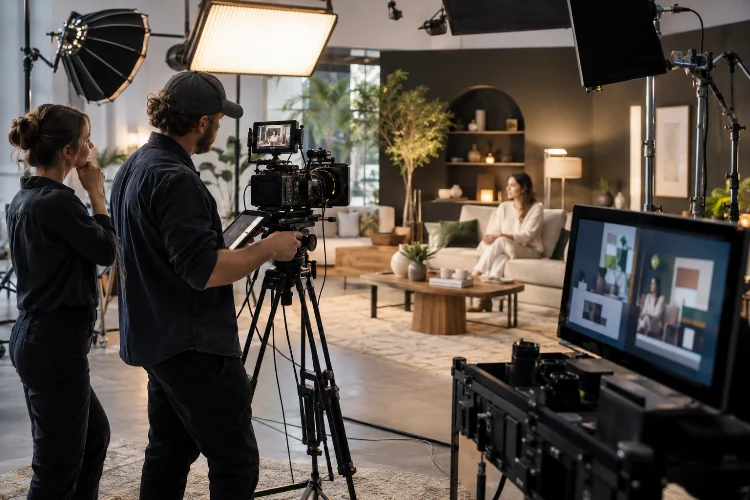
A polished video rarely becomes great simply because an expensive camera was used. Long before the first frame is recorded, dozens of decisions have already shaped what the audience will eventually see and hear.
That is why production planning has such a strong influence on final video quality.
Planning determines whether the team understands the creative goal, whether the right equipment reaches the right location, whether enough time exists for important shots, and whether editors receive footage that actually works together.
Adobe describes preproduction as a critical stage covering areas such as goal setting, concept development, storyboarding, scheduling, budgeting, financing, and hiring.
When these decisions are rushed, production becomes reactive. Crews spend valuable shooting time solving preventable problems, directors compromise shots, and editors later struggle to repair inconsistencies.
Good planning does the opposite. It creates the conditions that allow creative, technical, and operational decisions to work toward the same final result.
Production Planning Creates a Clear Creative Direction
Before worrying about cameras or locations, a production needs to know what the video is supposed to achieve.
A corporate brand film, documentary, product commercial, YouTube video, and cinematic short might all use similar production equipment, but their creative requirements are completely different.
Tone, pacing, camera movement, lighting, performance, music, and editing choices should support the intended audience and message.
Production planning turns an abstract idea into a clear creative blueprint.
That process may include scripts, treatments, mood boards, storyboards, visual references, and shot lists.
Adobe notes that storyboards help cinematographers visualize scenes shot by shot, while production scripts can include information about lighting and camera movement for the crew.
Without this preparation, different departments may interpret the project differently.
The director might imagine an intimate documentary style while the cinematographer prepares a polished commercial look. Both approaches could be technically excellent, yet combining them may create an inconsistent final video.
Better Scripts Lead to Better Images
The quality of a video often begins with the quality of its script.
A strong script does more than provide dialogue. It defines narrative structure, key visual moments, pacing, locations, talent requirements, props, and emotional transitions.
During preproduction, the script can be broken down into practical production elements.
StudioBinder identifies steps such as locking the shooting script, breaking it down, hiring department heads, finalizing the budget, creating storyboards and shot lists, securing locations, scheduling shoot days, and arranging equipment.
This detailed breakdown helps producers notice potential problems early.
For example, a script may describe a character walking through a busy train station at sunset. Creatively, that sounds simple.
Operationally, it could require location permissions, crowd management, limited shooting windows, additional lighting, transport, sound control, and several camera setups.
Solving those issues before filming protects the original creative idea instead of forcing the team to simplify it unexpectedly on set.
Scheduling Directly Affects Shot Quality
A schedule is not just an administrative document. It can influence what appears on screen.
Imagine a director needs six setups for an important scene but the schedule only allows enough time for three. The production might still finish the scene, but perhaps without close-ups, alternative angles, inserts, or additional performance takes.
Those missing options eventually become an editing problem.
Asana notes that tight budgets, changing crew schedules, and unpredictable shoot days can result in wasted time and missed shots. A structured shooting schedule helps organize scenes, personnel, timing, and production logistics.
Good scheduling considers more than the number of scenes per day.
Lighting changes, company moves, equipment setups, makeup, costume changes, actor availability, transportation, meal breaks, and location restrictions all consume time.
Professional production planning therefore creates realistic rather than optimistic schedules. Giving complex scenes enough breathing room can improve performance, lighting precision, camera movement, and overall consistancy.
Location Planning Shapes Visual and Audio Quality
A beautiful location is not automatically a good filming location.
Production teams need to consider natural light, noise levels, power access, equipment movement, parking, weather protection, permissions, and the physical space available for camera placement.
Technical scouts are especially useful here.
Suppose a team chooses an impressive office because of its floor-to-ceiling windows. During filming, they discover direct sunlight changes dramatically throughout the afternoon, while loud construction outside makes clean dialogue nearly impossible.
The location still looks great, but the final footage may suffer.
Proper scouting allows the cinematography, sound, lighting, art, and production departments to identify these issues beforehand. StudioBinder specifically includes location scouting and technical scouting among core preproduction responsibilities.
Sometimes the best production location is not the most visually dramatic one. It is the location that gives the crew enough control to consistently create the desired image and sound.
Equipment Choices Become More Purposeful
More equipment does not automatically produce better content.
A production could arrive with multiple cinema cameras, drones, gimbals, sliders, dozens of lenses, wireless monitors, and huge lighting packages. If these tools do not support the creative concept, they may simply slow the crew down.
Production planning connects technical decisions with storytelling requirements.
A handheld documentary might benefit more from compact cameras and lightweight lighting than from large cinema rigs. A luxury product commercial, on the other hand, could require macro lenses, precise motion control, large diffusion sources, and high-resolution acquisition.
These choices should ideally be made before filming.
Testing cameras, lenses, lighting, codecs, microphones, and other technical components also reduces surprises. It allows cinematographers and other department heads to understand limitations before the pressure of production begins.
The result is not simply better equipment management. It is more deliberate visual language.
Crew Coordination Prevents Quality From Breaking Down
Professional videos are collaborative products.
Directors, producers, cinematographers, camera assistants, lighting crews, production designers, wardrobe teams, sound recordists, makeup artists, editors, and many other specialists contribute different pieces of the final experience.
The challenge is making those pieces fit together.
Planning provides shared information so departments understand both their responsibilities and their dependencies. Production calendars, call sheets, shot lists, storyboards, script versions, and technical notes create a common reference point.
StudioBinder’s production planning tools, for example, emphasize calendars, task management, document sharing, contacts, shot lists, and collaboration across production teams.
This coordination becomes particularly important when something changes.
If a location moves but only part of the crew receives the update, lighting equipment might be inappropriate, wardrobe continuity could fail, or required props might never arrive.
Small communication errors can quickly become visible production flaws.
Budget Planning Protects Creative Priorities
Production quality always exists within financial limits.
Even projects with large budgets need to decide where money will create the greatest impact. For smaller teams, those choices become even more important.
A good production budget helps identify essential costs early rather than spending freely until money becomes tight.
Maybe an elaborate crane shot would consume a large part of the equipment budget while appearing for only three seconds.
The director might decide that the same money would improve the project more if invested in production design, additional shooting time, or professional sound.
Production calendars also help prevent financial problems. StudioBinder notes that poorly structured production timelines can contribute to slipping deadlines, expanding budgets, and workflow inefficiencies.
Budget planning therefore does not necessarily restrict creativity.
In many situations, it protects the most important creative elements by ensuring resources are available when they actually matter.
Planning Ahead Makes Post-Production Stronger
One of the biggest mistakes in video production is treating editing as a problem for later.
Post-production requirements should influence decisions before filming begins.
Editors need sufficient coverage. Visual-effects artists may need clean plates or tracking references. Colorists benefit from consistent exposure and camera settings. Sound teams need clean production audio, room tone, and appropriate microphone coverage.
Even file management matters.
If several cameras record different codecs, resolutions, color spaces, and frame rates without a defined workflow, the editing process can become unnecessarily complicated.
Planning the complete pipeline – from camera acquisition and backups to editing, sound, graphics, color grading, and final delivery – reduces this inefficency.
It also encourages crews to capture material editors actually need rather than simply collecting attractive shots.
A visually impressive close-up becomes much less useful if there is no matching wide shot, reaction shot, or transition that allows the editor to construct the sequence smoothly.
Contingency Planning Protects Quality Under Pressure
Video production rarely goes exactly according to plan.
Weather changes. Equipment fails. Actors become unavailable. Locations suddenly introduce new restrictions. Traffic delays the crew. Batteries disappear much faster than expected.
The purpose of planning is not to pretend these problems will never occur.
It is to prepare alternative options.
A weather-dependent exterior could have an indoor backup scene. Productions may carry spare audio equipment for critical interviews. A complicated shot might have a simpler alternative that preserves the same narrative purpose.
This type of preparation prevents teams from making desperate creative compromises when something unexpected happens.
Ironically, structured planning can make filmmakers more flexible.
When the essential logistics are already under control, the production team has more mental space to experiment, respond to performances, and explore unexpected creative opportunities.
Consistency Across Production Builds a More Professional Final Video
Audiences may not consciously analyze lighting ratios, lens choices, color temperature, wardrobe continuity, or sound perspective.
They still notice when something feels wrong.
Production planning helps maintain consistency between scenes and shooting days. Camera settings can be documented, visual references shared, wardrobe photographed, lighting diagrams recorded, and continuity notes maintained.
This becomes especially valuable when a project is filmed over several days or locations.
Without consistent documentation, one interview might have soft neutral lighting while another unexpectedly looks highly contrasty. One scene may use warm colors while connected footage appears noticeably cooler.
Individually, each shot might look good. Together, the project can feel disconected.
Planning creates visual and technical rules that help every production decision contribute to the same identity.
Production planning determines final video quality because almost every creative result depends on decisions made before or around the shoot.
Strong scripts, realistic schedules, appropriate locations, purposeful equipment choices, coordinated crews, controlled budgets, and post-production preparation all influence what ultimately reaches the screen.
Great planning does not guarantee that nothing will go wrong. Unexpected challenges are part of filmmaking. It simply gives the team better options when those challenges appear.
Instead of viewing planning as paperwork that delays the creative process, treat it as one of the tools that makes creative work possible.
Before your next video production, spend more time defining the workflow, identifying risks, and aligning the team. The quality improvement may become visible before the first edit is even finished.
