


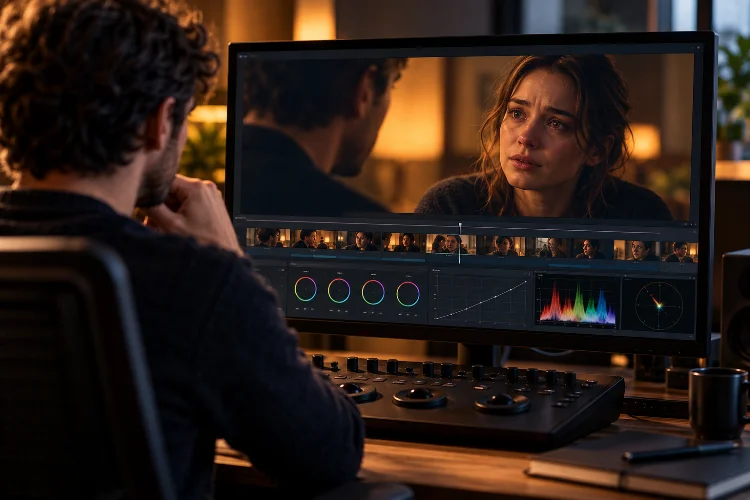
Sometimes the most important person in a scene is not the one speaking.
A character delivers surprising news, tells a joke, reveals a secret, or makes a difficult confession. The dialogue provides the information, but the real emotional impact often appears on someone else’s face.
A brief pause, uncomfortable glance, smile, or subtle change in expression can completely reshape how the audience understands what was just said. That is why reaction shots improve emotional continuity in video editing.
Adobe describes reaction shots as close-ups that capture a character’s emotional response to something happening elsewhere in the scene. These images can reveal feelings that would remain invisible if the edit stayed only on the person speaking.
For editors, reaction coverage does more than add variety. It connects dialogue with emotion, controls pacing, protects continuity between takes, and gives audiences a human reference point throughout a scene.
When used carefully, a reaction shot can make an edit feel emotionally seamless even when the underlying footage comes from completely different takes.
Reaction Shots Show What Dialogue Cannot
Dialogue explains what characters say.
Reaction shots reveal what those words actually mean to someone else.
Imagine a manager telling an employee, “The project has been approved.”
If the editor stays on the manager, viewers receive the information. Cut to the employee silently exhaling and smiling, however, and audiences immediately understand how much that approval matters.
The emotional meaning has expanded without another line of dialogue.
StudioBinder notes that reaction shots can direct audience emotion because physical responses often communicate information that words cannot. In some scenes, the listener’s expression becomes more important than the person delivering the dialogue.
This principle works outside fictional filmmaking too.
Corporate documentaries, interviews, testimonial videos, event films, and branded content all benefit from genuine reactions.
Someone listening thoughtfully during an interview can make a conversation feel more human than constantly showing whoever happens to be speaking.
Emotional Continuity Depends on Cause and Reaction
Continuity is usually discussed in technical terms.
The cup needs to remain in the same hand. A character should look in the correct direction. Their body position should match between cuts.
But there is another form of continuity: emotional continuity.
If something significant happens, audiences expect characters to respond appropriately.
Adobe’s explanation of shot-reverse-shot editing describes a common pattern: one person acts or speaks, the edit moves to whoever or whatever they are looking at, and then often returns to capture the resulting reaction.
This creates the impression of a continuous interaction even though multiple camera angles are being combined.
Reaction shots complete the emotional cause-and-effect chain.
Action creates response.
Dialogue produces expression.
A revelation produces shock.
Without that response, an important moment can feel strangely incomplete.
The audience may understand what happened intellectually but fail to feel its impact.
Reaction Shots Help Audiences Know How to Feel
Editors can subtly influence emotional interpretation through the reaction they choose to show.
Imagine someone making an unusual statement during a meeting.
Cut to another character smiling, and the moment may feel humorous.
Cut to someone looking worried, and exactly the same dialogue begins to feel threatening.
Hold on someone who appears confused, and the audience may start questioning the speaker’s credibility.
StudioBinder specifically identifies directing audience emotion as one of the main functions of reaction shots.
This does not mean manipulating audiences dishonestly.
It means recognizing that editing always creates interpretation.
The Kuleshov principle behind classical continuity editing shows that viewers naturally build meaning from the relationship between consecutive images.
A face is not interpreted in isolation.
Its meaning partly comes from what appears before and after it.
That makes reaction coverage one of the editor’s most useful emotional tools.
Listener Shots Make Conversations Feel More Natural
Real conversations do not consist only of people taking turns speaking.
People listen.
They blink, nod, hesitate, smile, look away, disagree silently, or prepare to respond.
Editing only the speaker can therefore make dialogue feel strangely artificial.
Shot-reverse-shot editing helps create the impression of one continuous conversation by alternating between participants while maintaining their spatial relationships.
Adobe notes that the technique is especially useful for dialogue because it allows filmmakers to show both communication and reaction.
The listener shot can be particularly valuable.
Imagine an executive explaining a difficult company decision during a documentary.
Instead of immediately cutting to the next speaker, staying briefly on another employee listening may reveal concern or understanding.
That reaction adds emotionaly relevant information without changing the dialogue.
The conversation suddenly feels less like a series of statements and more like an interaction between real people.
Reaction Timing Controls the Rhythm of a Scene
Reaction shots are not only about what the audience sees.
They are also about when they see it.
Cut too quickly to a reaction and the moment can feel forced.
Wait slightly longer and the audience may experience anticipation before discovering how someone responds.
StudioBinder notes that reactions help editors control pacing and can support comedy, dramatic buildup, or simply give audiences time to absorb important information.
Comedy demonstrates this clearly.
Someone delivers an absurd line.
The editor waits.
Then the video cuts to another character staring silently.
That small pause may be funnier than the dialogue itself.
Drama uses the same principle differently.
After devastating news, an editor might hold on the speaker before finally revealing the listener’s reaction.
The delay creates tension because viewers begin wondering what the response will be.
Timing gives the reaction weight.
Reaction Shots Give Editors More Flexibility
Reaction shots also solve practical editing problems.
Professional productions frequently combine dialogue from multiple takes.
Perhaps the best delivery of the first sentence comes from take three, while the strongest second half comes from take six.
Cutting directly between those performances may create a visible jump because the speaker’s head, hands, or body position changed.
A reaction shot provides somewhere useful to cut.
StudioBinder highlights this flexibility as a major reason editors value reaction coverage: cutting away to another character can help combine different performances while maintaining the impression of continuous action.
This is especially valuable in interviews.
An editor might remove a long pause, repeated phrase, or irrelevant sentence while temporarily showing the interviewer listening.
The dialogue becomes tighter without creating an obvious visual discontinuity.
The reaction shot is therefore both a storytelling tool and an editorial safety net.
Eyeline Matches Make Reactions Believable
Reaction coverage only works when viewers understand who is reacting to whom.
Eyeline direction becomes essential.
If two characters are facing each other, their close-ups should usually preserve consistent screen direction. One person may look toward screen right while the other looks toward screen left.
This creates the illusion that they occupy the same physical space.
MasterClass describes eyeline matching as an important continuity technique because the direction of each character’s gaze needs to remain believable when different shots are intercut.
The 180-degree rule supports the same goal.
Adobe explains that maintaining camera positions on one side of an imaginary axis generally preserves spatial relationships and keeps audiences focused on the actors instead of becoming distracted by geography.
A powerful reaction with incorrect eyelines can feel disconnected.
Emotion and spatial continuity therefore need to work together.
Close-Ups Make Small Reactions More Powerful
Reaction shots are often captured relatively close because subtle expression becomes easier to read.
A tiny eyebrow movement might disappear in a wide shot.
In close-up, it can completely change the meaning of a scene.
Adobe specifically describes reaction shots as opportunities for character and story development because they let viewers see emotional responses that a shot of the main action would miss.
This does not mean every reaction requires an extreme close-up.
Shot size should match emotional importance.
A mild response might work perfectly in a medium shot.
A major revelation could justify something tighter.
Editors can also create emotional progression through shot size.
Early reactions remain wider and more distant. As conflict increases, the edit gradually moves toward closer singles.
The visual language becomes more intimate as the emotional stakes rise.
Reactions Can Redirect Attention Without Breaking Continuity
Sometimes reaction shots function similarly to cutaways.
They temporarily move attention away from the main action while remaining emotionally connected to it.
Adobe explains that cutaway shots can add context without breaking continuity and may show either what someone is reacting to or information the subject has not yet noticed.
Reaction shots reverse that relationship.
Instead of showing the cause, they show the effect.
This creates useful editing patterns:
event, reaction, understanding.
A glass falls from a table.
Someone suddenly looks toward the sound.
The editor cuts back to the broken glass.
Three simple images create a small narrative.
The audience understands both the physical event and its human significance.
This continuty makes scenes feel connected even when several individual shots were filmed separately.
Reaction Shots Can Shift Point of View
Reaction coverage also helps determine whose emotional experience matters most.
Imagine three people receiving the same piece of information.
One is relieved.
Another is shocked.
The third is suspicious.
Choosing which reaction appears first changes the audience’s perspective.
Adobe describes shot-reverse-shot as a technique capable of expressing both literal and figurative character point of view.
Editors can therefore use reactions to move the emotional center of a scene.
A conversation may technically belong to the person speaking, but the edit can gradually shift attention toward the listener.
This technique is powerful in narrative storytelling.
Audiences sometimes realize that a scene was actually about the silent character only after noticing how frequently the edit returns to their face.
Words deliver the plot.
Reactions reveal whose story matters.
Good Reaction Coverage Should Be Planned During Production
Editors cannot use reaction footage that was never recorded.
This sounds obvious, but productions often focus heavily on dialogue and main action while treating reactions as optional coverage.
StudioBinder argues that reaction shots can make or break scenes and recommends including them deliberately during shot planning.
Directors can capture clean individual reactions after dialogue coverage.
They can also allow cameras to remain rolling before and after spoken lines.
Those extra seconds frequently contain valuable expressions.
Interview productions should follow the same principle.
Do not stop recording the instant someone finishes answering.
A relaxed smile, sigh, laugh, or thoughtful silence immediately afterward may later become the strongest emotional moment in the sequence.
Capturing more reation coverage gives editors choices rather than forcing them to manufacture continuity from limited footage.
Too Many Reaction Shots Can Become Predictable
Reaction coverage is powerful precisely because it tells audiences where emotional attention should go.
Overusing it can reduce that power.
If every sentence immediately receives a reaction shot, scenes become formulaic.
The editor begins following a predictable pattern:
speaker, listener, speaker, listener.
Professional editing introduces variation.
Sometimes stay on the speaker while another person reacts off-screen.
Sometimes remain on the listener while someone else continues talking.
Sometimes use a wide two-shot and allow both performances to exist simultaneously.
Walter Murch’s Rule of Six places emotion and story above mechanical editing rules, suggesting that editors should prioritize what feels emotionally truthful over rigid technical patterns.
Reaction shots should therefore serve the moment rather than simply filling coverage.
Emotional Continuity Matters More Than Perfect Matching
An interesting editing choice sometimes emerges when technical continuity and emotional continuity conflict.
Imagine the best reaction comes from a take where the actor’s hand position does not perfectly match the previous shot.
Should the editor use a weaker performance simply because the hand matches?
Not necessarily.
Walter Murch’s editing philosophy places emotion at the top of the decision hierarchy. Technical spatial continuity matters, but emotional truth matters more when compromises are necessary.
Audiences are surprisingly forgiving of tiny continuity errors when a scene feels emotionally correct.
They are much less forgiving when technically perfect editing feels lifeless.
The strongest reaction is often the shot that keeps the audience connected to what the character is experiencing.
That emotional connection should usually remain the priority.
Reaction shots improve emotional continuity in video editing because they connect events with human responses.
They reveal what dialogue cannot, guide audience interpretation, strengthen pacing, preserve continuity between different takes, and help editors shift emotional perspective without disrupting the scene.
Their power comes from timing and authenticity rather than frequency.
On your next production, capture reactions as deliberately as dialogue and main action. Record listeners, hold cameras after important lines, protect eyelines, and give editors several performance options.
Then, during post-production, avoid cutting to reactions automatically. Choose the moment when seeing someone’s response genuinely adds meaning. When reaction shots are timed correctly, audiences do not simply understand what happened – they understand how the moment feals.
