


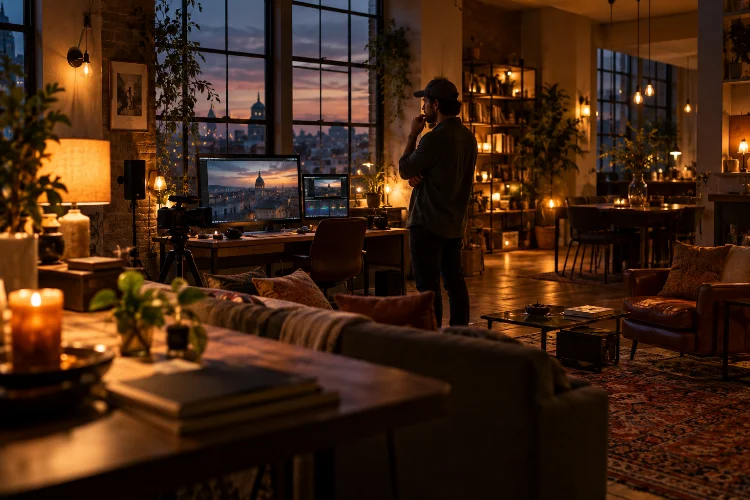
A room can be technically well exposed and still look flat. The subject may be properly lit, the background may be visible, and the camera settings may be correct, yet the image somehow lacks atmosphere.
One of the simplest ways cinematographers solve that problem is with practical lights.
Practical lights are visible light sources that exist inside the frame, such as table lamps, wall fixtures, candles, computer monitors, neon signs, televisions, streetlights, or decorative bulbs.
Unlike hidden production fixtures, practicals become part of both the lighting design and the physical environment.
StudioBinder describes practical lighting as visible illumination that can contribute to exposure while also helping explain where light in a scene appears to come from.
Used carefully, practicals do much more than decorate a background. They create visual layers, motivate off-camera lighting, separate subjects from their surroundings, and make locations feel more dimensional.
The result is often a scene that feels richer without looking obviously “lit.”
Practical Lights Create Visual Layers
Depth in cinematography often comes from separating foreground, subject, and background.
Practicals are extremely useful for this because they can be placed at different distances from the camera.
Imagine an interview shot.
The subject sits in the middle of the frame. A warm desk lamp glows several meters behind them, while a smaller practical appears closer to the foreground.
Suddenly, the frame contains multiple brightness levels and spatial layers.
The foreground practical establishes visual proximity. The subject becomes the central layer. The background lamp creates another point of interest deeper in the room.
Instead of everything existing on one flat plane, the image feels more three-dimensional.
No Film School notes that practical fixtures can help create depth by introducing highlights and visual separation across different areas of a frame.
This is especially useful in simple locations where production design is limited.
Practicals Make Backgrounds More Interesting
Empty backgrounds are difficult to make cinematic.
A plain office wall or dark corner may provide little visual information, even when the subject is well lit.
Adding one or two practical sources can transform the composition.
A lamp can create a warm pool on a wall. A monitor can introduce cooler light. A small decorative fixture can provide a highlight in an otherwise dark corner.
The goal is not to fill every empty space.
Too many lights can make the background look busy.
Instead, cinematographers usually look for strategic points where brightness can create balance or guide the viewer’s eye.
StudioBinder’s practical-lighting guidance emphasizes that fixtures visible within the frame can contribute both illumination and production design.
That combination is what makes them so useful.
They do not merely brighten the environment.
They make it feel inhabited.
Practical Lights Motivate Off-Camera Lighting
One of the strongest advantages of practicals is that they give artificial lighting a believable reason to exist.
Imagine a warm lamp sitting beside an actor.
The lamp itself might not be strong enough to properly expose the actor’s face.
The cinematographer can place a larger, softer fixture outside the frame and match its direction and color to the visible lamp.
The audience sees the practical and naturally assumes it is producing the stronger illumination.
This technique is called motivated lighting.
StudioBinder explains that practical sources are frequently used as motivation for stronger off-camera fixtures.
The result is controlled lighting that still feels natural.
Without the practical, the warm key light might appear arbitrary.
With it, the lighting feels connected to the environment.
That small visual explanation makes the scene more believable.
Warm and Cool Practicals Can Create Color Separation
Color temperature is another way practicals create depth.
A warm tungsten-style lamp in the background can contrast beautifully with a cooler daylight key on the subject.
The difference creates color separation between layers.
For example, a corporate interview might use neutral daylight on the face while warm lamps glow behind the speaker.
The subject feels clean and natural, while the background gains richness.
The reverse can also work.
A warm key combined with cooler monitors or blue practicals in the environment can create a more technical or nighttime mood.
Practical lighting should still feel motivated.
Randomly adding orange and blue sources simply because the combination looks “cinematic” can become artificial quickly.
The strongest color contrast usually has a logical relationship with the location.
Brightness Control Is Critical
A practical light can easily become too bright.
When the bulb is significantly brighter than the surrounding exposure, it may clip into a white shape with no texture.
Instead of adding atmosphere, it becomes distracting.
No Film School recommends controlling practical intensity with dimmers, lower-output bulbs, diffusion, or repositioning.
Modern LED bulbs make this process easier because brightness and color temperature can often be adjusted independently.
The practical does not necessarily need to light the whole scene.
Sometimes it only needs to appear believable on camera.
A desk lamp may be dimmed until the shade retains detail while a hidden production fixture provides the actual illumination.
This separation between visible brightness and functional lighting is extremely useful.
The practical explains the light.
The off-camera fixture controls it.
Practical Lights Can Guide Audience Attention
Brightness naturally attracts the eye.
Cinematographers can use practicals to influence where viewers look inside the frame.
Suppose an actor stands in a large room.
A bright lamp directly behind them may create a visual anchor that keeps attention near the subject.
Another practical farther to the side can balance the composition without competing for attention.
The placement matters.
A very bright fixture near the edge of frame may pull the viewer away from the main subject.
Good cinematography therefore considers practicals as part of visual hierarchy.
Their brightness, position, size, and color should support the important elements of the scene.
A practical can lead the eye.
It can also become a distraction if it is not controlled.
Practicals Add Depth Through Localized Illumination
Real environments rarely have perfectly even lighting.
A table lamp creates one pool of brightness.
A monitor creates another.
A hallway fixture illuminates part of the background.
These local variations make environments feel dimensional.
If every wall, object, and person receives exactly the same exposure, the image can become flat.
Practical sources break that uniformity.
StudioBinder notes that practical lighting often contributes to realism because it creates illumination that appears connected to actual architectural or environmental sources.
A darker corner beside a warm lamp feels natural.
A face illuminated by a nearby monitor makes visual sense.
These pockets of brightness and shadow create depth without requiring complex production lighting across the entire set.
They Help Separate Subjects From Dark Backgrounds
Night interiors are especially dependent on separation.
A person wearing dark clothing in a dark room can disappear into the background.
Traditional solutions might include a backlight or rim light.
Practicals offer another option.
A lamp positioned behind the subject can create a brighter area that separates the silhouette.
A wall sconce might produce a highlight around one side of the frame.
A monitor could provide a cool patch of brightness behind a darker figure.
The practical itself may not touch the subject.
It still improves separation because the background value changes.
This is an important distinction.
Not every lighting tool needs to illuminate the actor directly.
Sometimes the better solution is changing the environment around them.
Practical Placement Should Support Composition
Lighting and composition should be designed together.
A practical placed randomly in a room may look accidental.
A practical placed deliberately can strengthen balance, framing, and visual rhythm.
Imagine an interview composition with the subject positioned on the left third of the frame.
A small warm lamp in the right background can counterbalance the subject.
The frame feels more stable.
If that lamp were directly behind the person’s head, however, it might create a distracting visual overlap.
Cinematographers often adjust practical placement by only a few centimeters to improve composition.
Production designers and camera teams therefore benefit from working together.
A fixture may function as decoration, lighting, and compositional structure simultaneously.
Practical Lights Can Establish Time and Place
Practical lighting also communicates context.
Warm bedside lamps suggest evening or intimacy.
Fluorescent ceiling fixtures can make an office feel institutional.
Streetlights imply nighttime exterior environments.
Computer monitors suggest modern workspaces.
Candles may communicate romance, ritual, or historical periods.
These signals help audiences understand a location quickly.
A scene does not always need dialogue explaining where and when it takes place.
The lighting environment can provide that information visually.
This is particularly valuable in professional branded content where time is limited.
A few carefully chosen practical sources can communicate atmosphere within seconds.
The audience understands the world before anyone speaks.
Practical Sources Need Consistency Across Coverage
A practical source creates lighting logic that needs to remain believable when camera angles change.
If a warm lamp motivates light from camera right in the wide shot, the reverse close-up should usually respect that direction.
The production fixture may need to move completely between setups.
The resulting illumination should still appear to come from the same practical.
This is where continuity becomes important.
Reference stills, lighting diagrams, exposure notes, and color-temperature settings can help crews maintain consistancy.
Otherwise, one angle may appear warm and directional while another suddenly becomes flat or cool.
The viewer may not consciously identify the problem, but the scene can feel visually disconnected.
Practicals Work Best When They Are Not Overused
A room filled with visible lamps, neon signs, candles, monitors, and decorative bulbs can certainly look dramatic.
It can also look extremely artificial.
The strongest practical lighting often comes from restraint.
One or two carefully placed sources may create more depth than ten competing ones.
Every visible light should have a reason to exist.
Does it explain the key light?
Does it improve background separation?
Does it establish atmosphere?
Does it help composition?
If the answer is no, the practical may simply add cluter.
Professional cinematic lighting is usually about hierarchy rather than maximum complexity.
Practical Lights Should Work With Negative Fill
Practicals create light, but controlling nearby shadows is just as important.
Suppose a warm table lamp adds beautiful background depth.
Meanwhile, white walls are bouncing so much light around the room that the subject’s face looks flat.
Negative fill can remove that unwanted bounce.
A black flag or dark fabric on the shadow side deepens contrast without changing the practical setup.
This combination works particularly well in cinematic interviews.
The practicals give the environment warmth and depth.
Negative fill keeps the subject sculpted.
Together, they create a more controlled image than simply adding more fixtures.
Realistic Practical Lighting Still Requires Exposure Control
Real locations often contain practical fixtures with very different brightness levels.
A television may be too bright.
A decorative lamp may be too dim.
A window might dominate the entire scene.
Professional cinematographers rarely accept those levels exactly as they exist.
They balance them.
Bulbs may be replaced.
Monitors may be dimmed.
Window exposure may be controlled with ND gel.
Hidden fixtures may reinforce weak practical sources.
The result should feel natural, but the process is highly intentional.
That is the paradox of cinematic realism.
The more effortless the final frame looks, the more control may have been required behind the camera.
Practical Lighting Supports Long Takes
Practical sources are especially useful when the camera moves through a large environment.
Traditional fixtures become difficult to hide when a tracking shot sees multiple directions.
Visible lamps and architectural lighting can provide natural motivation throughout the movement.
A character might pass from warm lamp light into cooler hallway illumination and then toward a bright window.
Instead of fighting those changes, the cinematographer can design the shot around them.
This creates a more dynamc lighting experience.
The environment itself becomes part of the lighting choreography.
That can make long takes feel more believable than trying to keep every part of the subject perfectly illuminated at all times.
Practical lights add depth to cinematic video environments because they do more than provide illumination.
They create visual layers, improve background separation, motivate hidden production lights, guide audience attention, introduce color contrast, and make locations feel believable.
The key is control.
A practical should not simply be switched on and left alone. Its brightness, placement, color, relationship with the subject, and effect on the overall composition all matter.
On your next production, look around the location before bringing in additional fixtures. Identify existing lamps, monitors, architectural lights, or other practical sources that can become part of the visual design.
Then shape them intentionally. When practicals support both lighting and storytelling, even simple environments can gain significantly more depth, atmosphere, and cinematic character.
