


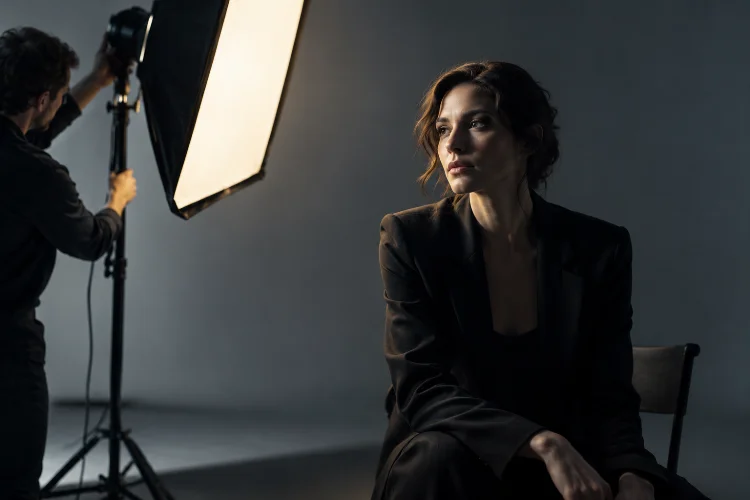
Move one light a few feet, and the person in front of the camera can suddenly feel like a completely different character.
Place the key light close to the camera and a face may appear open, friendly, and accessible.
Move that same source farther to the side and stronger shadows begin to appear, creating more mystery or seriousness. Raise it, lower it, soften it, or move it behind the subject, and the emotional impression changes again.
This is why key light placement is such an important part of cinematic storytelling.
The key light is normally the primary source shaping the subject. Its angle, height, hardness, intensity, and relationship to the camera determine how facial structure and shadows appear.
StudioBinder notes that key-light angle has a major influence on the dimensions, form, and mood of a subject. Professional cinematographers therefore do not place the key simply to achieve correct exposure.
They place it to influence how audiences perceive the person being filmed.
Front Lighting Can Make Characters Feel Open and Accessible
When the key light remains relatively close to the camera axis, shadows become less pronounced.
Both sides of the face receive more similar illumination, reducing visible contrast.
This can create a friendly, clear, and approachable appearance.
Corporate interviews, beauty content, lifestyle advertising, tutorials, and presenter-led videos often benefit from this type of setup because the audience needs to connect easily with the subject.
The effect is especially strong when the source is large and soft.
A broad frontal source minimizes harsh facial shadows and presents information clearly.
However, moving the light too close to the camera axis can make faces appear flatter because less shadow exists to reveal three-dimensional structure.
The subject may look pleasant but lose some visual depth.
That is why many professional setups begin slightly off-axis rather than completely frontal.
A 45-Degree Key Creates Natural Facial Shape
One of the most common key-light positions is roughly 45 degrees from the camera and slightly above eye level.
StudioBinder identifies approximately 45 degrees as a frequently used position because it creates visible shadow while still keeping the face readable.
This arrangement often feels natural.
One side of the face receives the primary illumination while the nose, cheek, and jaw create gentle shadows on the opposite side.
Those shadows reveal facial shape.
For interviews, documentaries, commercials, and many narrative scenes, this placement provides a useful balance between accessibility and cinematic depth.
It can make a subject feel confident without becoming overly dramatic.
This is also why simply positioning a large softbox directly in front of someone may not produce the same sophistication.
Softness helps skin.
Direction creates form.
Side Lighting Can Add Mystery or Conflict
Move the key farther around the side of the subject and the shadow side becomes increasingly dominant.
At around 90 degrees, the light may illuminate one side of the face while allowing the opposite side to fall significantly darker.
This creates strong visual separation.
StudioBinder categorizes side and split lighting as useful techniques for emphasizing texture, depth, duality, or conflict.
Imagine filming a founder discussing a successful product launch.
Moderate side lighting might make the person look thoughtful and authoritative.
Now imagine the same person discussing a difficult ethical decision.
Allowing more of the face to disappear into shadow can add uncertainty and psychological weight.
The person has not changed.
The audience’s interpretation has.
This illustrates how lighting works almost like performance direction.
It quietly tells viewers how emotionally comfortable they should feel.
High Key Placement Changes Facial Structure
Horizontal placement is only one variable.
Height matters too.
Most naturalistic key lights sit slightly above the subject’s eye line because many real-world sources – windows, overhead daylight, architectural fixtures – commonly illuminate people from above.
MasterClass notes that raising a key can strengthen cheekbone definition and produce longer nose shadows, while the exact effect depends on how high the source moves.
A slightly elevated soft source often looks flattering.
Raise it much higher and eye sockets may become darker.
The subject can begin to appear more serious, tired, intimidating, or emotionally distant.
This can work well for dramatic scenes.
It can be problematic in a friendly interview.
Cinematographers therefore watch the eyes carefully.
A beautifully shaped face can still feel lifeless if the eyes become too dark.
Low-Angle Key Light Can Feel Unnatural or Threatening
Move the key below eye level and facial shadows begin behaving in ways viewers rarely see naturally.
Noses cast shadows upward.
Eye sockets brighten from below.
Cheeks and brows take on unusual shapes.
MasterClass notes that low-positioned key lighting can distort familiar facial structure and is often effective when filmmakers want discomfort, abnormality, horror, or comedy.
The classic flashlight-under-the-face horror effect uses exactly this principle.
Human beings are accustomed to light arriving from above.
When illumination reverses that expectation, something feels wrong even before the audience understands why.
Low-angle lighting should therefore be used intentionally.
In most professional interviews, it would probably feel strange.
In a stylized narrative scene, music video, or suspense project, it may be exactly what the character needs.
Short Lighting Can Make Faces Feel More Dramatic
Key placement also changes depending on which side of the face is closest to the camera.
In short lighting, the key illuminates the side of the face turned away from the camera.
The side closest to camera falls darker.
This creates a narrower illuminated area and usually increases the sense of depth.
StudioBinder notes that placing the key on the far or “smart” side of the face is common in cinematic three-point setups because it keeps the camera side relatively shadowed while preserving smooth facial modeling.
This technique can make a subject feel more serious or visually refined.
It is common in documentary interviews and narrative cinematography where filmmakers want dimension without losing naturalism.
It also creates stronger separation between light and shadow across the face.
That contrast can make the image feel less like standard studio lighting and more like intentional cinematography.
Broad Lighting Can Make a Subject Feel More Open
Broad lighting does the opposite.
The side of the face closest to the camera receives the key.
More illuminated skin is visible to the viewer, and the darker side turns away.
This generally creates a wider, brighter impression.
The setup can feel open and friendly, especially when paired with soft light and moderate fill.
It may also reduce the dramatic quality created by short lighting.
This is useful when the goal is warmth rather than mystery.
A presenter introducing an educational program may benefit from broader illumination.
A character hiding information during an interrogation scene probably would not.
Neither technique is inherently superior.
They communicate different visual personalities.
Key Light Hardness Changes How Placement Is Perceived
Placement cannot be separated from source quality.
A hard key at 60 degrees creates very different facial modeling from a huge soft source at the same angle.
StudioBinder notes that hard sources produce stronger, sharper shadows, while soft sources create gentler transitions across a subject.
This means a side key does not automatically need to feel aggressive.
Make the source large enough and the shadow transition can remain elegant.
Likewise, a nearly frontal hard source may still emphasize skin texture and facial lines.
Professional lighting therefore combines placement with hardness.
The angle decides where shadows fall.
Source size determines how those shadows transition.
Together, they create the emotional character of the face.
Fill Light Changes the Meaning of the Key
Key placement never exists in isolation.
Fill determines how much of the shadow remains visible.
StudioBinder explains that fill intensity can range from relatively strong commercial-style illumination to much lower levels for more cinematic and dramatic contrast.
Imagine using the same 45-degree key for two scenes.
In the first, strong fill keeps the shadow side bright.
The subject feels polished and approachable.
In the second, the fill is removed and negative fill is added instead.
Now the same key creates much stronger contrast.
The subject may appear more serious or mysterious.
The key has not moved.
Its psychological effect changed because the lighting ratio changed.
This is why judging placement without considering the rest of the setup can be misleading.
Eye Light Can Change Emotional Accessibility
A small reflection in the eyes can dramatically affect how alive and connected a subject appears.
When the key is positioned well, it often produces a natural catchlight.
Move the source too far around the side or too high, and that reflection may disappear.
The image can still look cinematic, but the character may feel less emotionally accessible.
This can be useful.
A character who should feel distant or threatening may benefit from darker eyes.
An interview subject discussing a personal story may need visible catchlights to maintain connection with the audience.
This tiny detail demonstrates how key-light placement affects preception beyond simple exposure.
Viewers notice eyes instinctively.
Lighting them deliberately can change the emotional relationship between subject and camera.
Character Perception Should Guide Placement
There is no universal “correct” key-light position.
The right placement depends on what the audience should feel.
Should the person seem trustworthy?
Powerful?
Fragile?
Mysterious?
Energetic?
Relaxed?
Once that question is answered, lighting decisions become easier.
A friendly presenter may benefit from a large source slightly off camera.
A dramatic character might need far-side lighting and reduced fill.
A threatening figure may work with harder side or top illumination.
A vulnerable character could be shaped with soft window-style light that leaves gentle shadow rather than aggressive contrast.
The technical setup follows the emotional objective.
Background and Environment Also Influence Perception
Lighting a character does not stop at the face.
The brightness and color of the environment affect how key placement is interpreted.
A softly lit face against a bright background can feel airy.
The same face against deep shadow may appear much more dramatic.
No Film School demonstrates how cinematographers can combine directional key light, negative fill, bounce, and background exposure to create stronger visual separation within ordinary locations.
This is why a key should always be evaluated inside the complete frame.
A setup that looks perfect during a close-up lighting test might feel completely different once background practicals or windows enter the composition.
Character perception comes from relationships, not individual fixtures.
Lighting Continuity Keeps Character Perception Stable
If a character should feel emotionally consistent across a scene, key direction should usually remain believable between angles.
Imagine a wide shot where the key clearly comes from screen left.
The close-up suddenly places it from the opposite direction.
The actor’s face may still look attractive, but the lighting logic changes.
This can subtly disrupt continuity.
Professional crews therefore document source direction, height, intensity, color, and exposure.
The actual fixtures may move between setups, especially when shooting reverses.
The apparent lighting direction should remain consistant unless the change is intentional.
Continuity helps maintain not only visual realism, but also emotional identity.
Small Changes Can Produce Large Psychological Effects
One of the best ways to understand key placement is simply to experiment.
Put a subject in front of the camera and slowly move one source around them.
Start near the lens.
Move to 30 degrees.
Then 45.
Then 70.
Raise the source.
Lower it.
Watch the face change in real time.
StudioBinder recommends using a stand-in and judging how light actually falls on a person rather than relying only on diagrams.
You will quickly notice that the same actor can appear friendlier, older, more serious, more mysterious, or more vulnerable without changing wardrobe, lens, or performance.
That is the subtelty and power of lighting.
Key light placement changes character perception on camera because light determines which facial features are emphasized, where shadows appear, and how much emotional access audiences receive.
Frontal lighting can feel open, a 45-degree key creates natural dimension, side lighting adds drama, high placement strengthens facial structure, and low-angle illumination can feel unsettling.
There is no single placement that works for every person or scene.
Before setting your next key light, decide what the character should communicate emotionally. Then experiment with angle, height, softness, fill, and background exposure until the lighting supports that intention.
Do not stop when the face is simply visible. Keep shaping the source until the person feels right for the story. That is when key lighting becomes more than exposure—it becomes character design.
