


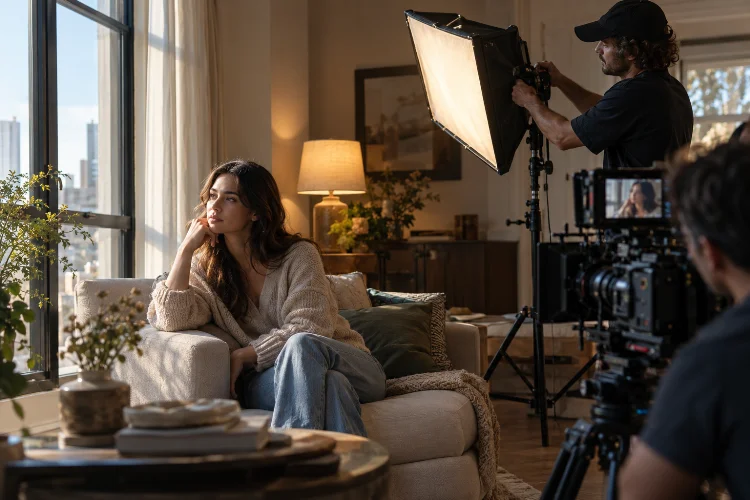
Professional lighting does not always need to look dramatic to be effective. In many cases, the strongest lighting is the kind viewers barely notice because it feels like it naturally belongs inside the scene.
That is the basic idea behind motivated lighting.
Instead of placing light on a subject simply because the camera needs more exposure, cinematographers ask where that light could logically come from. A window might motivate a soft daylight key.
A desk lamp could justify warm light on someone’s face. A television, streetlight, phone screen, or car headlight can provide another believable reason for illumination.
StudioBinder describes motivated lighting as lighting that appears to come from a logical source within the world of the scene, even when additional off-camera fixtures are actually doing most of the work.
This approach improves realism because audiences understand the visual logic almost instantly. The lighting can still be shaped, exaggerated, softened, or stylized – but it does not feel random.
Motivated Lighting Gives Every Light a Visual Reason
The biggest strength of motivated lighting is simple: the audience understands where the light is coming from.
If a character sits beside a large window, bright directional light from that side feels natural.
If the strongest light suddenly comes from the opposite direction with no visible explanation, the scene may still look attractive, but it can feel less believable.
StudioBinder explains that motivated light helps build immersive worlds because off-camera fixtures can be justified by windows, lamps, computer screens, candles, or other sources visible or implied within the scene.
This visual logic matters even when audiences do not consciously analyze it.
People intuitively understand light.
We know sunlight comes through windows, lamps create warmer pools of illumination, and screens usually create localized light around faces.
When cinematography follows those expectations, the scene becomes easier to accept.
Practical Lights Make Artificial Lighting Feel Natural
Practical lights are sources that appear inside the frame.
They include table lamps, ceiling fixtures, candles, monitors, televisions, decorative bulbs, headlights, and streetlights.
No Film School notes that practicals are especially useful because they motivate artificial lighting and help audiences suspend disbelief about where illumination is coming from.
However, the visible practical does not always provide enough light for the camera.
A bedside lamp may look perfect in the background but be far too weak to properly expose an actor.
The cinematographer can solve this by placing a stronger fixture off camera and matching its direction and color to the practical.
The audience sees the lamp and assumes that it is producing the warm light across the actor’s face.
Technically, the real source may be a large diffused LED several feet away.
Visually, the illusion remains believable.
Light Direction Is Essential for Realism
A motivated source needs more than the correct color.
Its direction also has to make sense.
Imagine a daylight interior with a large window on the right side of frame.
If the actor’s strongest key light also comes from the right, the image feels logical.
If a bright source suddenly illuminates the actor from the opposite side without explanation, the illusion becomes weaker.
StudioBinder specifically notes that window-motivated lighting works because the direction of the artificial source follows the position of the window.
Direction also affects shadow behavior.
Window light usually creates a broader, directional pattern.
A desk lamp might produce a lower, warmer source.
An overhead fixture naturally creates downward shadows.
Understanding those relationships helps cinematographers design lighting that feels connected to the environment rather than placed independently of it.
Color Temperature Supports the Illusion
Real locations rarely contain only one color of light.
Daylight may appear relatively cool compared with a tungsten lamp. A television could add blue-green tones. Streetlights may introduce warm amber or cooler LED colors.
Motivated lighting can use these differences to increase realism.
StudioBinder emphasizes the importance of matching or intentionally relating the color temperature of artificial fixtures to the practical sources they are supporting.
For example, if a candle motivates the key light, using a very cool source on the actor would probably feel inconsistent.
A warmer fixture makes more sense.
At the same time, filmmakers do not need every light to match perfectly.
Mixing warm and cool sources can create separation, atmosphere, and depth.
The important part is maintaining believable consistancy between the visible source and the light it appears to generate.
Motivated Lighting Creates Depth Without Looking Artificial
Realistic lighting should not mean flat lighting.
In fact, practical and motivated sources can create strong depth.
No Film School notes that practical lights positioned at different distances from the camera can create layers, separation, specular highlights, and background interest.
Imagine an interview filmed at night.
A warm desk lamp sits behind the subject. Another practical glows in the deep background. Cooler light enters through a window.
The subject now exists between several lighting layers.
The practicals create background separation while stronger off-camera fixtures can shape the face.
The image feels cinematic because it has depth, but it also remains believable because every major lighting direction has a visible or implied motivation.
This is far more convincing than simply placing random colored lights around the room.
Motivated Lighting Works Especially Well in Wide Shots
Wide compositions can be difficult to light because more of the environment becomes visible.
Large fixtures, stands, flags, and cables become harder to hide.
This is where practical lighting becomes particularly useful.
StudioBinder highlights the diner scenes in Moonlight as an example where practical fixtures helped illuminate a location that needed to remain visible in wider framing.
Existing fixtures can sometimes be modified with stronger bulbs or replaced with controllable LED sources.
The cinematographer may then add subtle off-camera fill or shaping.
This approach keeps the lighting visually connected to the architecture.
Instead of the characters appearing perfectly lit inside an otherwise dark room, the whole environment feels like one coherent lighting system.
Exposure Should Feel Natural, Not Accidentally Dark
Motivated lighting is sometimes confused with simply using whatever light already exists.
That can create poor results.
Realism does not mean accepting underexposed faces, ugly overhead fixtures, or uncontrolled highlights.
Professional cinematographers often enhance natural or practical sources significantly.
A window may motivate the scene, but large diffusion outside could soften the sunlight. An artificial fixture might add several times more output than the real window provides.
A practical lamp may remain visible, while a larger source off-screen produces the flattering light on the actor.
StudioBinder notes that motivated lighting does not have to be strictly naturalistic; it simply needs to feel logically connected to the world of the scene.
That distinction gives filmmakers freedom.
The goal is believable illumination, not literal reproduction.
Practicals Need Brightness Control
A practical lamp can easily become distracting if its bulb is massively overexposed.
Instead of adding realism, it becomes a bright white blob.
No Film School recommends controlling practical intensity with tools such as dimmers so the visible fixture remains visually useful rather than clipping excessively.
Modern LED bulbs also provide useful control over output and color temperature.
This allows cinematographers to balance the practical against the exposure of the subject.
Sometimes the practical only needs to look bright enough to justify another source.
It does not need to produce all of the illumination physically.
Controlling practical brightness also preserves texture.
A lamp shade, filament, or decorative fixture can remain visible instead of disappearing into an overexposed highlight.
That small detail improves realism.
Motivated Lighting Helps Long Takes Feel Believable
Long tracking shots create special lighting challenges.
The actor may cross several parts of a room while the camera changes direction.
Traditional lighting can become difficult because fixtures that look perfect from one angle may suddenly appear in frame.
Motivated practical sources provide a useful solution.
StudioBinder notes that practical lighting can be especially effective when wide portions of a set need to remain visible or when scenes involve longer takes.
A character can move from window light into a warmer lamp-lit area.
The lighting changes naturally as the environment changes.
Rather than trying to keep the actor’s face perfectly identical throughout the take, the cinematographer allows the space itself to influence the exposure and color.
The scene feels more dynamc while still remaining visually coherent.
Motivated Light Can Support Storytelling
Realism is not the only advantage.
Motivated lighting can also reinforce narrative meaning.
Imagine a character working alone late at night.
A single desk lamp creates a small warm pool around them while the rest of the office falls into cooler darkness.
The lighting feels realistic because the lamp is visible.
It also communicates isolation.
StudioBinder notes that practical lighting can perform both technical and narrative functions, helping shape atmosphere while explaining where light comes from.
A television can cast shifting light across someone’s face during an uneasy scene.
Car headlights can suddenly enter a dark room before a character arrives.
A window can gradually lose daylight as a conversation continues into evening.
Motivation gives the cinematographer a believable foundation.
Story determines how that foundation is shaped.
Realism Still Requires Shape and Contrast
A common mistake is assuming realistic lighting should illuminate everything evenly.
Real environments rarely work that way.
Light falls off.
Corners become darker.
Objects block sources.
Faces change exposure as people move.
Professional cinematographers preserve some of these natural variations.
Negative fill can deepen shadows. Flags can prevent unwanted spill. Diffusion can soften window light without eliminating its direction.
Practical sources can create small pools rather than filling the whole room.
StudioBinder’s broader lighting guidance emphasizes that motivated illumination can still be shaped extensively while remaining believable to audiences.
The result is a scene that feels natural without appearing visually accidental.
Realism often comes from controlled imperfection.
Lighting Continuity Matters Across Multiple Angles
Motivated lighting also provides a useful reference when filming coverage.
If the key source is established as a window, every angle should generally respect that direction.
This simplifies visual continuity.
The cinematographer can adjust fixtures between setups, but the apparent source remains consistent.
A close-up might use softer, more flattering diffusion than the wide shot.
A reverse angle may require completely repositioning the equipment.
As long as the resulting light still appears to come from the established window, audiences accept the transition.
Without a clear motivation, each angle can begin feeling like a separately lit image.
That inconsistancy becomes especially noticeable during dialogue scenes.
Motivation gives the entire sequence one visual logic.
Professional Lighting Often Hides Its Complexity
Some of the most natural-looking scenes require surprisingly complicated setups.
Large diffusion frames, powerful LEDs, negative fill, dimmed practicals, bounce materials, and hidden fixtures may all contribute to an image that looks like someone simply switched on a lamp.
That is not a contradiction.
It is the craft.
Motivated lighting is not about using fewer tools.
It is about hiding the tools behind believable visual logic.
The audience should feel the room, time of day, mood, and character environment without constantly wondering why someone’s face is perfectly illuminated.
When the technique works, the lighting becomes invisible.
The scene feels real even though almost every part of the illumination may have been carefully designed.
Motivated lighting improves realism in professional video scenes because it gives illumination a believable source, direction, color, and relationship with the environment.
Windows, practical lamps, monitors, streetlights, candles, and other visible sources can justify much more sophisticated off-camera lighting.
The goal is not to reproduce reality literally.
It is to create lighting that audiences instinctively accept as belonging to the scene.
On your next production, begin by studying the location before placing fixtures. Identify where the light should logically come from, then shape and enhance those sources rather than fighting them.
Control practical brightness, match direction and color, and maintain continuity across angles. When lighting feels motivated, viewers stop noticing the setup and start believing the world in front of them.
